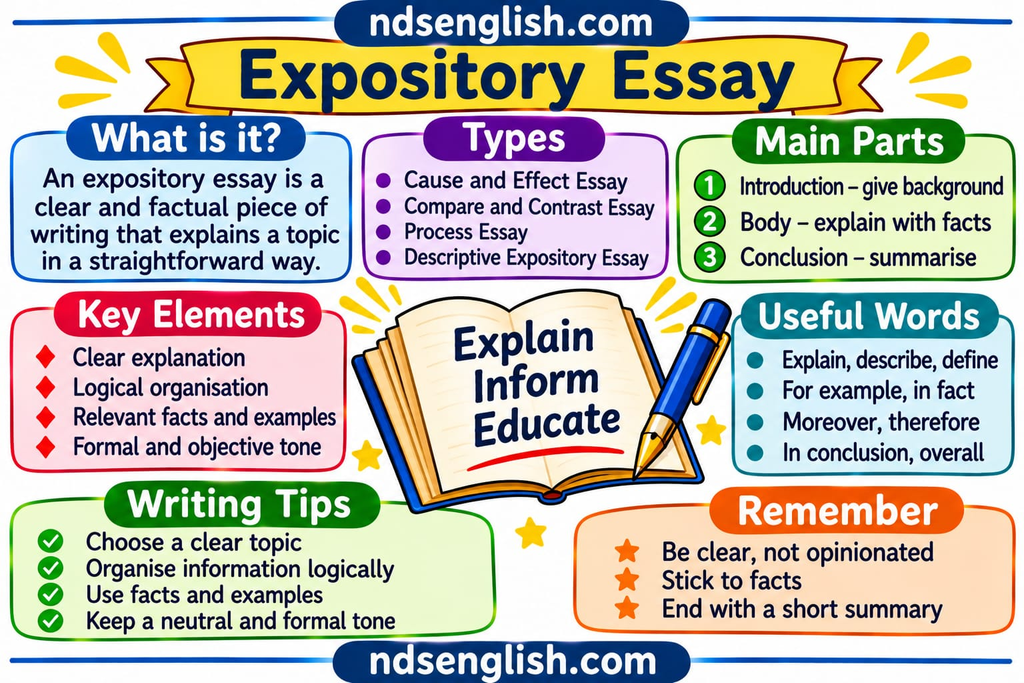
What is an Expository essay?
An expository essay explains a topic clearly using facts, examples, and logical explanations. Its primary purpose is to help readers gain a clear understanding of a subject. Unlike a persuasive essay, which aims to convince readers to agree with a particular viewpoint, an expository essay focuses on providing information in a clear and organized way.
An expository essay generally has three parts
- Introduction: Introduces the topic and gives the reader some background information.
- Body Paragraphs: Develop the topic using relevant facts, examples, and supporting details.
- Conclusion: Sumarises the main ideas and brings the essay to a close.
The following examples discuss The Importance of Reading at three levels: beginner, intermediate, and advanced. Each essay follows this three-part structure, but the vocabulary, sentence structure, and depth of explanation vary according to the reader’s level.
1. Beginner-Level Expository Essay
The Importance of Reading
Reading is a useful habit that helps us learn new things. Books teach us about people, places, animals, and the world around us. They also help us learn new words and improve our English.
When we read stories, we discover different characters and their experiences. Some stories also teach us valuable lessons about honesty, kindness, and friendship. Reading regularly can improve our spelling and help us write better sentences. We can read storybooks, newspapers, magazines, and other interesting materials.
Reading is beneficial for children as well as adults.Reading for a few minutes each day can strengthen our language skills and broaden our knowledge.
Features of the Beginner Level
- Vocabulary: Uses simple, familiar words that children can easily understand.
- Sentences: Relies mainly on short and straightforward sentences.
- Explanation: Introduces the basic benefits of reading.
- Paragraph development: Presents ideas without lengthy explanations.
- Purpose: Helps young learners understand a topic and explain it in simple language.
2. Intermediate-Level Expository Essay
The Importance of Reading
Reading helps us develop our knowledge, improve our language skills, and understand the world around us. Books, newspapers, magazines, and reliable online articles help us learn about topics we may not come across in our daily lives
One important benefit of reading is vocabulary development. When we encounter unfamiliar words, we can often figure out their meanings from the sentences around them. Reading also improves comprehension by helping us identify the main ideas and understand how different points are connected. Reading different writing styles also helps us organise our ideas and communicate them more clearly.
Books also introduce us to new subjects and experiences. Science books help us understand how nature works, while history books teach us about significant events from the past. Reading different kinds of material allows us to gain knowledge beyond what we learn in the classroom.
In conclusion, reading improves our language skills and expands our knowledge of different subjects. By reading regularly, students can strengthen their communication skills and become more confident, independent learners.
Features of the Intermediate Level
- Vocabulary: Includes more precise words, such as comprehension, development, and historical accounts.
- Sentences: Combines simple sentences with longer, connected sentences.
- Explanation: Develops each benefit with relevant details.
- Paragraph development: Groups related ideas into separate paragraphs.
- Purpose: Explains the topic through supporting information and clear connections between ideas.
3. Advanced-Level Expository Essay
The Role of Reading in Intellectual and Language Development
Reading is essential for strengthening thinking skills, improving language abilities, and gaining knowledge. It allows us to discover new information, consider different viewpoints, and understand ideas beyond our own experiences. By encouraging curiosity and continuous learning, reading plays a valuable role in education and personal development throughout life.
Reading helps us develop stronger language skills. It introduces us to new words, different sentence patterns, and various writing styles. By seeing how language is used in different situations, we learn to express our thoughts more clearly and accurately. Reading regularly also enhances our ability to understand written information and communicate effectively through writing.
Reading also encourages critical thinking. Readers must often connect information, interpret explanations, and distinguish between well-supported claims and unsupported statements. For instance, studying historical accounts from different sources can reveal how interpretations of the same event may differ. Similarly, scientific texts explain natural phenomena through evidence and reasoned explanations.
Reading also plays an important role in helping people learn independently.Books and trustworthy sources help people explore topics they find interesting and expand their knowledge beyond what they learn in school. However, readers must also consider the reliability of their sources, particularly when information is incomplete, inaccurate, or contradictory.
In conclusion, reading contributes to linguistic ability, intellectual development, and independent learning. When readers engage thoughtfully with reliable material, they can develop a clearer understanding of complex subjects and apply their knowledge in different areas of life.
Features of the Advanced Level
- Vocabulary: Uses precise terms such as language proficiency, critical thinking, and independent learning.
- Sentences: Includes varied sentence structures to express relationships between ideas.
- Explanation: Examines the connections between reading, language, reasoning, and knowledge.
- Paragraph development: Develops each main idea through explanation and relevant examples.
- Critical depth: Recognises the importance of evaluating the reliability of information.
- Purpose: Provides a detailed explanation supported by reasoning and examples rather than simply listing the benefits of reading.
The main distinction is the depth of explanation.
A beginner-level essay introduces the essential information, an intermediate-level essay develops that information with supporting details, and an advanced-level essay examines the subject more thoroughly through reasoning and evaluation.
The topic remains the same, but the writer’s vocabulary, sentence structure, and approach to explaining ideas become more sophisticated at each level.