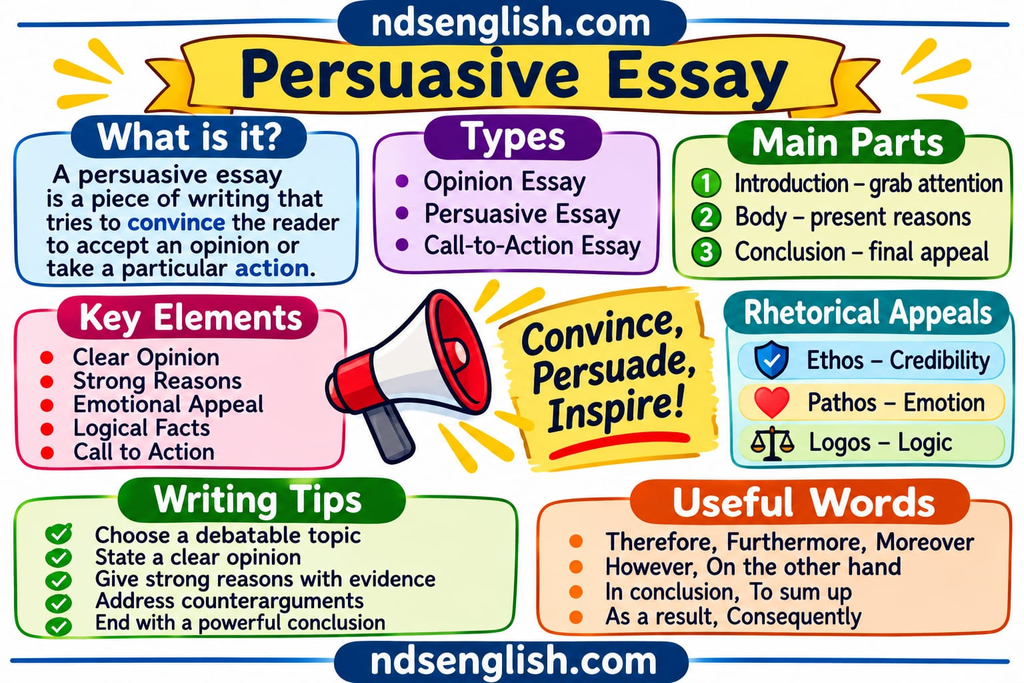
What is a Persuasive Essay?
A persuasive essay is a piece of writing in which the writer expresses a particular opinion or viewpoint and attempts to convince the reader to agree with it or take a specific action.
The writer presents convincing arguments, logical explanations, relevant examples, and persuasive language to influence the reader’s thoughts, feelings, or decisions.
The primary purpose of a persuasive essay is not merely to provide information but to make the reader accept or consider the writer’s point of view.
Meaning of Persuasive
The word persuasive means having the ability to convince someone to believe, accept, or agree with a particular idea, opinion, or argument.
In writing, persuasion means presenting ideas in such a convincing manner that readers are encouraged to consider or accept the writer’s viewpoint.
For example:
If you believe that school uniforms should be compulsory, you must provide convincing reasons to make readers understand why your opinion is reasonable.
Persuasive Techniques:
Persuasive techniques are methods used by writers to influence readers and make their arguments more convincing.
There are several techniques that students can incorporate into their writing.
A. The Three Classical Persuasive Appeals
These three techniques are associated with the Greek philosopher Aristotle.
1. Ethos – Appeal to Credibility
Ethos refers to establishing the writer’s credibility, knowledge, experience, and trustworthiness.
The writer attempts to gain the reader’s confidence by demonstrating knowledge of the subject.
Example:
“As an experienced teacher, I strongly believe that every child deserves access to quality education.”
Here, the writer establishes credibility by referring to professional experience.
2. Pathos – Appeal to Emotions
Pathos refers to appealing to the emotions and feelings of readers to influence their opinions.
The writer uses emotional language, personal experiences, and relatable situations to develop feelings such as sympathy, compassion, happiness, concern, or responsibility.
Example:
“Imagine a young child who dreams of attending school but cannot afford even the most basic educational materials. Should poverty deprive a child of the opportunity to receive an education?”
Here, the writer appeals to the reader’s sympathy and sense of compassion.
3. Logos – Appeal to Logic and Reason
Logos refers to convincing readers through logical reasoning, facts, evidence, examples, and explanations.
The writer presents reasonable arguments to demonstrate why a particular opinion should be accepted.
Example:
“Regular reading improves vocabulary, strengthens comprehension, and develops critical-thinking skills. Therefore, schools should encourage students to develop a daily reading habit.”
Here, the writer uses logical reasoning to support the argument.
Remember:
An effective persuasive essay can combine all three techniques:
- Ethos – Establish credibility.
- Pathos – Appeal to emotions.
- Logos – Appeal to logic and reason.
Persuasive writing is not based on emotions alone. A combination of credibility, emotional appeal, and logical reasoning makes an argument more convincing.
Parts of Persuasive essay
A persuasive essay generally consists of three main structural parts:
- Introduction
- Body
- Conclusion
Let us understand each part separately.
1. Introduction
The introduction is the opening section of a persuasive essay. It introduces the topic, attracts the reader’s attention, and establishes the writer’s position.
It generally consists of three elements:
A. Hook
A hook is an interesting opening statement, question, observation, or fact that captures the reader’s attention.
Example: “Have you ever wondered how a simple school uniform can influence the way students feel about equality?”
B. Background Information
This provides some introductory information about the topic so that readers understand the subject being discussed.
C. Thesis Statement
A thesis statement is a sentence that clearly expresses the writer’s main opinion or position.
Example: “School uniforms should be compulsory because they promote equality, encourage discipline, and create a sense of unity among students.”
2. Body
The body is the main section of a persuasive essay. It contains the arguments and explanations that support the writer’s position.
It generally consists of several paragraphs, each discussing a particular reason or argument.
The body may include:
A. Supporting Arguments
These are the main reasons presented to convince readers.
Example:
“School uniforms promote equality because students from different financial backgrounds wear the same clothes.”
B. Explanations and Examples
The writer explains each argument and supports it with relevant examples, facts, observations, or experiences.
C. Counterargument
A counterargument is an opposing opinion or viewpoint that challenges the writer’s position.
Although the writer is writing independently, the opposing viewpoint is introduced to acknowledge what someone who disagrees might think.
Example:
“Some people argue that compulsory school uniforms restrict students’ freedom of expression.”
D. Rebuttal
A rebuttal is the writer’s response to the opposing argument. It explains why the opposing viewpoint does not necessarily weaken the writer’s position.
Example:
“However, students can express their individuality through their talents, creativity, opinions, and achievements rather than relying entirely on their clothing.”
Important distinction:
Counterarguments and rebuttals are useful components of persuasive writing, particularly at intermediate and advanced levels. However, they are not compulsory in every persuasive essay, especially at the beginner level.
3. Conclusion
The conclusion is the final section of a persuasive essay. It brings the discussion to a meaningful close and reinforces the writer’s position.
It generally includes:
- Restating the thesis statement in different words.
- Briefly summarising the main arguments.
- Ending with a strong persuasive statement or call to action.
Example:
“School uniforms play an important role in creating an organised and inclusive learning environment. They encourage equality, discipline, and unity. Therefore, schools should maintain reasonable uniform policies while respecting students’ individuality.”
PERSUASIVE ESSAY WRITING AT THREE DIFFERENT LEVELS
For the following examples, we will use the same topic at all three levels.
Common Topic: Should School Uniforms Be Compulsory?
The essays are written in original wording, with vocabulary and sentence structures appropriate to each learning level.
A. BEGINNER LEVEL
Topic: Should School Uniforms Be Compulsory?
1. Introduction
School uniforms should be compulsory in every school because they make students feel equal, teach discipline, and create a sense of unity. Every student should wear a uniform because it helps maintain a common standard in school.
2. Body Paragraph 1 – Equality
Firstly, school uniforms help students feel equal. Not every child comes from a wealthy family, and some parents cannot afford expensive clothes. When everyone wears the same uniform, students do not have to worry about wearing fashionable or costly outfits. They can concentrate on their studies instead of comparing their clothes with those of their classmates.
3. Body Paragraph 2 – Discipline
Secondly, school uniforms teach students discipline. Wearing a proper uniform helps children understand the importance of following rules. It also teaches them to be responsible and maintain a neat appearance.
4. Body Paragraph 3 – Unity
Additionally, uniforms help foster a sense of togetherness among students. When children wear the same clothes, they feel that they belong to one school community. This encourages friendship and togetherness.
5. Counterargument
Some people believe that students should be allowed to wear clothes of their choice because everyone has different preferences.
6. Rebuttal
However, students can express their individuality through their talents, hobbies, creativity, and behaviour. Wearing a uniform does not prevent them from developing their own personalities.
7. Conclusion
In conclusion, school uniforms are beneficial because they promote equality, discipline, and unity. They help create a common identity among students. Therefore, every school should encourage students to wear uniforms regularly.
B. INTERMEDIATE LEVEL
Topic: Should School Uniforms Be Compulsory?
1. Introduction
Education is not simply about acquiring knowledge from textbooks; it is also about developing discipline, responsibility, and respect for others. A school’s environment plays an important role in shaping students’ attitudes and behaviour. Therefore, school uniforms should be compulsory because they promote equality, reduce unnecessary competition, and strengthen a sense of belonging among students.
2. Body Paragraph 1 – Equality
One of the most significant advantages of school uniforms is that they reduce visible differences in appearance and clothing. Students come from families with different financial circumstances, and not everyone can afford expensive or fashionable outfits. When children are expected to wear the same uniform, the pressure to compete through clothing becomes less significant. This can help create a more comfortable and inclusive learning environment.
3. Body Paragraph 2 – Discipline and Responsibility
Another important reason is that uniforms encourage discipline and responsibility. Students learn to follow a common dress code and understand that educational institutions have certain standards. Wearing a clean and appropriate uniform also teaches them to take care of their appearance and develop a sense of responsibility.
4. Body Paragraph 3 – Unity and Belonging
Furthermore, uniforms help strengthen the connection between students and their school. Wearing a common dress creates a visible sense of identity and reminds students that they are part of a larger community. It can encourage teamwork, cooperation, and mutual respect.
5. Counterargument
However, some people argue that compulsory uniforms restrict students’ freedom of expression. They believe that children should have the opportunity to choose their clothing and develop their individual identities. After all, personal freedom is an important aspect of growing up.
6. Rebuttal
Although personal expression is important, clothing is not the only way to demonstrate individuality. Students can express themselves through their creativity, opinions, talents, and achievements. A reasonable uniform policy does not prevent children from developing their unique personalities.
7. Conclusion
To conclude, school uniforms provide several educational and social benefits. They encourage equality, promote discipline, and develop a sense of unity among students. Although individual freedom should be respected, maintaining a reasonable uniform policy can contribute to a more organised and inclusive school environment.
C. ADVANCED LEVEL
Topic: Should School Uniforms Be Compulsory?
1. Introduction
A school is more than an institution where children acquire academic knowledge; it is a social environment in which they develop their identities, attitudes, and understanding of collective responsibility. Within this environment, even seemingly ordinary practices can influence students’ experiences. School uniforms, in particular, have remained a subject of considerable discussion. While some regard them as an unnecessary restriction on personal freedom, compulsory uniforms can serve an important purpose by encouraging social equality, reinforcing institutional identity, and establishing a disciplined learning environment. For these reasons, schools should retain a reasonable and well-considered uniform policy.
2. Body Paragraph 1 – Social Equality
One of the strongest arguments in favour of compulsory school uniforms is their potential to reduce visible economic differences among students. Children come from diverse socioeconomic backgrounds, and their families do not possess equal financial resources. In schools without a uniform policy, differences in clothing may become an additional source of social comparison and pressure. Although uniforms cannot eliminate economic inequality itself, they can reduce the extent to which financial differences are displayed through everyday clothing. This allows students to participate in a shared educational environment without feeling that their appearance determines their social standing.
3. Body Paragraph 2 – Discipline and Institutional Identity
Equally important is the role uniforms can play in developing discipline and institutional responsibility. A consistent dress code establishes a common standard that students are expected to respect. Learning to follow reasonable institutional guidelines prepares young people to understand the importance of responsibility, cooperation, and mutual respect. Furthermore, a uniform can strengthen a student’s association with the educational institution, encouraging a sense of membership and collective identity.
4. Body Paragraph 3 – A Focused Learning Environment
Another significant consideration is the creation of a focused academic environment. When schools establish clear expectations regarding appropriate clothing, they may reduce certain distractions associated with fashion competition and appearance-based comparisons. However, it would be unreasonable to suggest that uniforms automatically improve academic performance. Their value lies primarily in supporting a structured school culture rather than directly guaranteeing educational success.
5. Counterargument – Individual Freedom
Nevertheless, opponents of compulsory uniforms raise a legitimate concern about individual freedom. Clothing can be a form of personal expression, and students should have opportunities to develop their identities without feeling unnecessarily restricted. Moreover, a rigid uniform policy may create difficulties for families when clothing is expensive, uncomfortable, or unsuitable for particular weather conditions. These concerns deserve serious consideration rather than dismissal.
6. Rebuttal – Balancing Individuality with Discipline
However, supporting a uniform policy does not require schools to disregard individuality or personal circumstances. Institutions can address these concerns by introducing affordable clothing options, providing suitable seasonal alternatives, and allowing reasonable flexibility in matters that do not affect the educational environment. Such an approach can preserve the benefits of a common dress code while respecting students’ comfort and dignity.
7. Conclusion
Ultimately, the purpose of education is not to make every student identical but to create an environment in which individuals from different backgrounds can learn and develop together. School uniforms, when implemented thoughtfully and fairly, can contribute to this objective. They may not resolve every social difference or guarantee academic success, but they can reinforce equality, institutional identity, and collective responsibility. Therefore, compulsory school uniforms remain a worthwhile educational practice, provided that schools balance discipline with individual freedom.
The Golden Rule of Persuasive Writing
Do not merely tell your readers what you believe. Give them convincing reasons to understand why they should believe it too.
Remember:
- Ethos: Make your readers trust you.
- Pathos: Make your readers feel something.
- Logos: Make your readers think logically.
- Persuasive techniques: Make your arguments memorable and convincing.
The ultimate objective is to influence the reader’s thinking through a combination of credibility, emotion, logic, and effective communication.