Idioms Related to Sadness and Disappointment
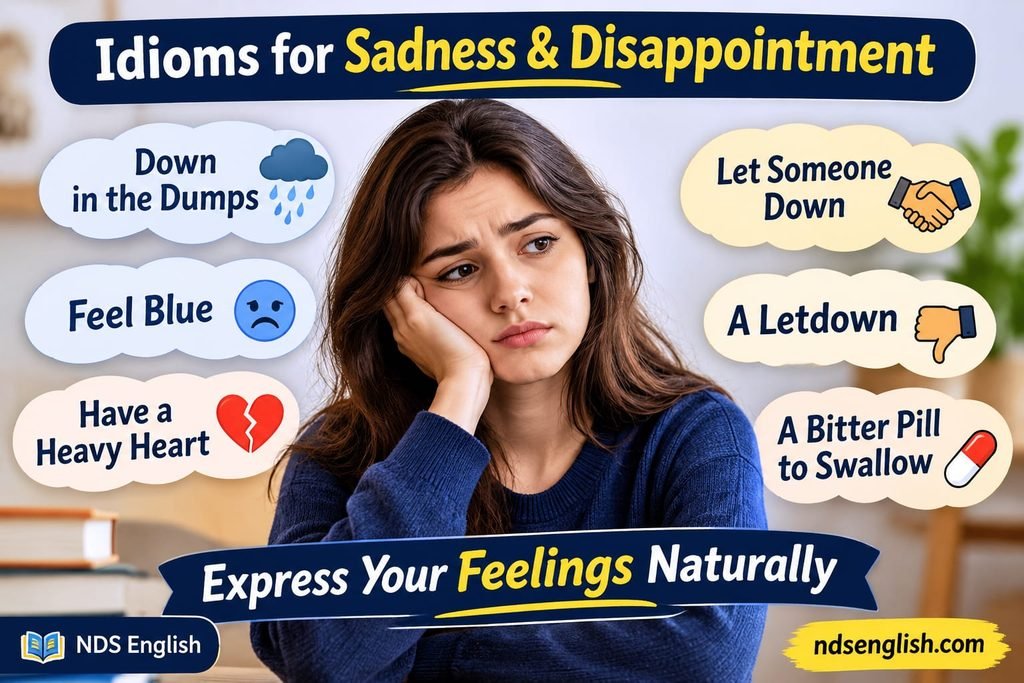
Idioms are expressions whose meanings often differ from the literal meanings of the individual words. They make communication more natural, expressive, and interesting. In everyday conversations, people frequently use idioms to describe their emotions, particularly when they experience sadness, disappointment, frustration, or emotional distress.
Learning these expressions helps English learners communicate their feelings more effectively. The following idioms are useful in both spoken and written English.
1. Idioms Expressing Sadness
These idioms describe different degrees of sadness, unhappiness, and emotional discomfort.
1. Down in the dumps
Meaning: To feel unhappy, discouraged, or low in spirits.
Example: She has been down in the dumps since her close friend moved to another city.
2. Feel blue
Meaning: To experience sadness or a temporary feeling of unhappiness.
Example: I sometimes feel blue when I remember my school days.
3. In low spirits
Meaning: To feel unhappy, discouraged, or lacking enthusiasm.
Example: He was in low spirits after receiving the disappointing news.
4. Have a heavy heart
Meaning: To experience deep sadness, particularly when facing an emotional situation.
Example: She left her hometown with a heavy heart.
5. Cry one’s heart out
Meaning: To cry intensely because of overwhelming sadness.
Example: The little girl cried her heart out when her parents left for their journey.
6. Wear a long face
Meaning: To look sad or disappointed.
Example: You have been wearing a long face all morning. Is something troubling you?
7. Broken-hearted
Meaning: To experience intense emotional sadness, particularly after losing someone or something important.
Example: He was broken-hearted when his closest friend moved abroad.
8. Downhearted
Meaning: To feel discouraged, unhappy, or disappointed.
Example: Do not feel downhearted because of one unsuccessful attempt.
2. Idioms Expressing Disappointment
These expressions are used when something does not happen as expected or when someone’s actions fail to meet our expectations.
1. Let someone down
Meaning: To disappoint someone by failing to fulfil their expectations or promises.
Example: I expected him to support me, but he let me down.
2. A letdown
Meaning: An experience, event, or situation that turns out to be disappointing.
Example: The much-awaited event turned out to be a complete letdown.
3. Fall short of expectations
Meaning: To fail to achieve the standard or result that someone had anticipated.
Example: The team’s performance fell short of the audience’s expectations.
4. Not live up to expectations
Meaning: To be less satisfactory or impressive than someone had hoped.
Example: The new restaurant did not live up to our expectations.
5. Burst someone’s bubble
Meaning: To destroy someone’s excitement, hope, or unrealistic belief by revealing an unpleasant truth.
Example: I do not want to burst your bubble, but the competition has already ended.
6. Get one’s hopes up
Meaning: To become excited or optimistic about something that one expects to happen.
Example: She got her hopes up after receiving the interview invitation.
7. A bitter pill to swallow
Meaning: An unpleasant or disappointing situation that is difficult to accept.
Example: Not being selected for the scholarship was a bitter pill to swallow.
8. A rude awakening
Meaning: A sudden and unpleasant realisation that a situation is very different from what one had expected.
Example: His first experience of professional life was a rude awakening.
3. Idioms Expressing Deep Sorrow and Emotional Pain
These expressions communicate stronger emotions and are particularly useful when describing difficult personal experiences.
1. Heart-wrenching
Meaning: Extremely sad or emotionally painful.
Example: The documentary presented a heart-wrenching account of a family’s struggles.
2. A lump in one’s throat
Meaning: A feeling of strong emotion that makes it difficult to speak.
Example: She had a lump in her throat while delivering her farewell speech.
3. Tears well up
Meaning: When tears begin to gather in someone’s eyes because of sadness or strong emotions.
Example: Tears welled up in her eyes as she listened to the farewell message.
4. Be at one’s wits’ end
Meaning: To feel extremely worried or frustrated because one cannot find a solution to a problem.
Example: The parents were at their wits’ end trying to understand their child’s behaviour.
5. Take something to heart
Meaning: To become deeply affected by someone’s words, actions, or criticism.
Example: You should not take every negative comment to heart.
6. A heavy burden on one’s heart
Meaning: A matter that causes considerable emotional worry or sadness.
Example: The unresolved disagreement remained a heavy burden on his heart.
4. Common Expressions Used to Communicate Disappointment
Apart from idioms, several everyday expressions help people communicate sadness and disappointment naturally.
- What a shame! – Used to express regret or disappointment about an unfortunate situation.
Example: What a shame! We missed the final performance. - That’s a real pity! – Used when something unfortunate happens.
Example: You could not attend the programme? That’s a real pity! - What a disappointment! – Used when something does not meet expectations.
Example: The exhibition was poorly organised. What a disappointment! - I am gutted. – An informal British English expression meaning extremely disappointed or upset.
Example: I am absolutely gutted that our team lost the final. - It breaks my heart. – Used to express deep sadness about a particular situation.
Example: It breaks my heart to see people suffering. - I am feeling low. – Used to communicate that one is feeling unhappy or emotionally discouraged.
Example: I am feeling a little low today. - I was taken aback. – Used when something unexpected causes surprise or shock.
Example: I was taken aback by his sudden decision. - That was the last thing I expected. – Used when something happens that one had never anticipated.
Example: His unexpected resignation was the last thing I expected.
5. Practice Exercise
Complete the following sentences using suitable idioms or expressions from the lessons above.
- She has been __________ since she failed to secure the position.
- I trusted him to keep his promise, but he __________ me __________.
- Losing the opportunity was a __________ pill to swallow.
- He was in __________ spirits after hearing the disappointing news.
- The much-publicised programme turned out to be a complete __________.
- She had a __________ in her throat while saying goodbye to her colleagues.
- Do not feel __________ just because you did not succeed the first time.
- I do not want to __________ your bubble, but the tickets are already sold out.
- The unexpected news left everyone __________ aback.
- She left her childhood home with a __________ heart.
Answers
- Down in the dumps
- Let; down
- Bitter
- Low
- Letdown
- Lump
- Downhearted
- Burst
- Taken
- Heavy
Conclusion
Idioms make English communication more expressive by helping speakers convey emotions in a natural and meaningful manner. Expressions related to sadness and disappointment are particularly useful because they allow us to describe feelings that ordinary vocabulary may not always communicate effectively.
Regular practice with these idioms, along with their meanings and examples, can improve vocabulary, comprehension, and conversational fluency. Learners should try incorporating a few of these expressions into their everyday conversations and written communication.