Comprehension and its Importance: Levels of Comprehension: The Foundation of Effective Learning and Communication
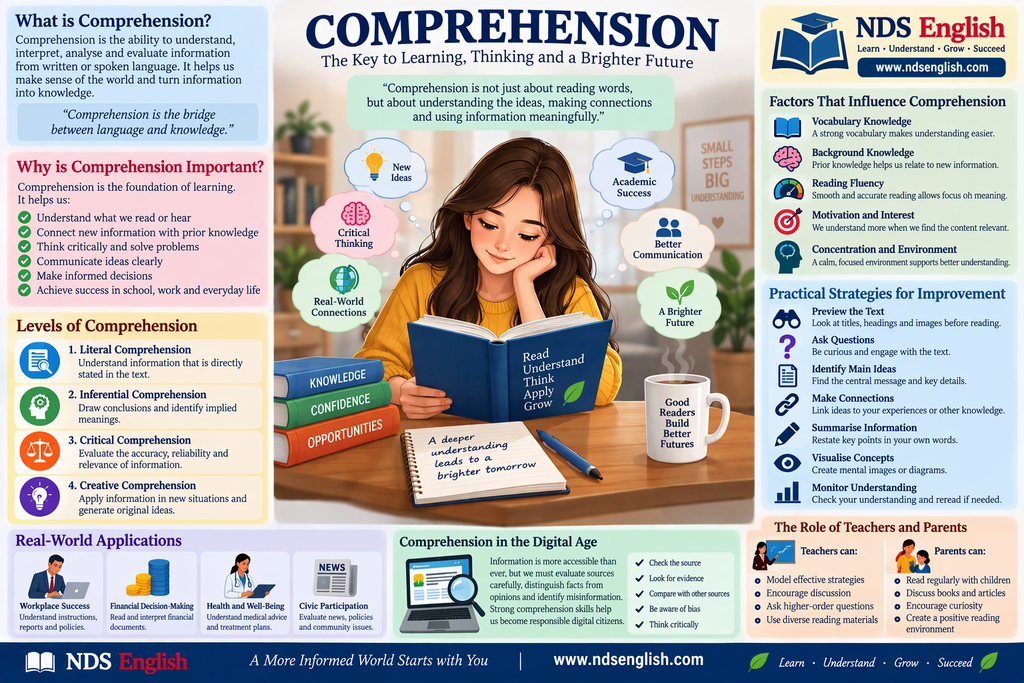
What is Comprehension?
Comprehension is one of the most essential skills in language learning and overall education. It is far more than the ability to read words and recognize their meanings. Comprehension involves understanding, interpreting, analyzing, and evaluating information to construct meaning from written or spoken language. It enables individuals to connect ideas, solve problems, communicate effectively, and make informed decisions. In today’s information-rich world, strong comprehension skills are necessary not only for academic success but also for personal and professional growth.
Understanding Comprehension
At its core, comprehension is the process of making sense of information. When people read a passage, listen to a lecture, watch a documentary, or engage in a conversation, they use comprehension skills to understand the intended message. This process requires readers or listeners to combine the information presented with their existing knowledge and experiences.
For example, when a student reads an article about climate change, comprehension involves more than understanding individual words such as “temperature,” “emissions,” or “environment.” The student must recognise how these concepts relate to one another, identify the author’s main argument, draw conclusions from the evidence provided, and perhaps evaluate the effectiveness of the proposed solutions.
Without comprehension, reading becomes a mechanical activity in which words are recognised but meaning is not fully understood. Therefore, comprehension serves as the bridge between language and knowledge.
The Importance of Comprehension in Education
Comprehension is often described as the cornerstone of learning because almost all academic activities depend upon it. Students are constantly exposed to new information through textbooks, classroom discussions, instructions, assessments, and digital resources. Their ability to understand and process this information determines how effectively they learn.
Consider a science classroom where students are studying the water cycle. A student with strong comprehension skills can understand the processes of evaporation, condensation, and precipitation and explain how these stages are interconnected. In contrast, a student who struggles with comprehension may memorise definitions without grasping the underlying concepts.
Similarly, comprehension plays a critical role in mathematics. Many students find mathematical word problems challenging not because they lack calculation skills but because they have difficulty understanding what the problem is asking. The ability to identify relevant information, interpret instructions, and determine the required solution depends heavily on comprehension.
In subjects such as history, geography, literature, and social sciences, comprehension enables students to analyse events, compare perspectives, identify causes and effects, and develop reasoned arguments. Thus, comprehension is not confined to language classes; it influences performance across the entire curriculum.
Levels of Comprehension
Comprehension develops progressively through several levels, each requiring increasingly sophisticated thinking skills.
1. Literal Comprehension
Literal comprehension involves understanding information that is directly stated in a text. Readers identify facts, dates, names, locations, and other explicit details.
For example, if a passage states that “The first modern Olympic Games were held in Athens in 1896,” a literal comprehension question might ask:
Where were the first modern Olympic Games held?
The answer can be found directly in the text.
2. Inferential Comprehension
Inferential comprehension requires readers to read between the lines and draw conclusions based on clues in the text.
For instance, if a story describes dark clouds gathering and people rushing indoors with umbrellas, readers can infer that rain is likely approaching even if the author never states it directly.
This level encourages logical reasoning and deeper engagement with the material.
3. Critical Comprehension
Critical comprehension involves evaluating information and forming judgments about its quality, reliability, and relevance.
For example, when reading an online article about a health product, a critical reader might ask:
- Is the information supported by evidence?
- Is the source trustworthy?
- Does the author present balanced arguments?
Critical comprehension is particularly valuable in the digital age, where misinformation and biased content are easily accessible.
4. Creative Comprehension
Creative comprehension occurs when readers extend their understanding beyond the text.
They may:
- Predict alternative endings.
- Imagine different solutions to problems.
- Apply learned concepts to new situations.
- Generate innovative ideas inspired by the material.
For example, after reading a story about environmental conservation, students might propose their own community initiatives to reduce waste and protect natural resources.
Factors That Influence Comprehension
Several factors affect a person’s ability to understand and interpret information effectively.
Vocabulary Knowledge
Vocabulary is one of the strongest predictors of comprehension success. Readers who understand a larger number of words can process texts more efficiently and accurately.
For example, a student reading a passage about renewable energy will struggle if unfamiliar with words such as “sustainable,” “turbine,” or “photovoltaic.”
Background Knowledge
People understand new information more easily when it relates to something they already know.
A cricket enthusiast reading a sports article will likely comprehend it faster than someone unfamiliar with the game because prior knowledge provides a context for understanding.
Reading Fluency
Fluency refers to the ability to read accurately, smoothly, and with appropriate speed. When readers spend excessive effort decoding individual words, less mental energy remains available for understanding meaning.
Motivation and Interest
Interest increases engagement. Readers are generally more focused and persistent when reading topics they enjoy or find personally relevant.
Concentration and Environment
External distractions and internal factors such as fatigue, anxiety, or stress can significantly affect comprehension. A calm and focused environment often leads to better understanding.
Practical Strategies for Improving Comprehension
Fortunately, comprehension is a skill that can be developed through practice and effective learning strategies.
Preview the Material
Before reading, learners should examine titles, headings, subheadings, images, graphs, and summaries.
For example, before reading a chapter on the Solar System, students can review section headings such as “The Inner Planets” and “The Outer Planets” to build expectations about the content.
Ask Questions
Active readers continuously ask questions before, during, and after reading.
Questions may include:
- What is the main idea?
- Why did this happen?
- What evidence supports this claim?
- What might happen next?
Questioning encourages deeper engagement with the text.
Identify Main Ideas and Supporting Details
Readers should learn to distinguish essential information from minor details.
For example, in an article about healthy eating, the main idea may focus on maintaining a balanced diet, while supporting details explain specific nutrients and their functions.
Make Connections
Effective readers connect information to:
- Personal experiences
- Other texts
- Current events
- Prior learning
These connections strengthen understanding and memory retention.
Summarise Information
Summarising requires learners to restate key ideas using their own words.
For example, after reading a chapter, students might write a five-sentence summary highlighting the most important concepts.
This process reinforces understanding and reveals areas that may need further clarification.
Visualise Concepts
Creating mental images or diagrams can support comprehension.
When reading about a historical battle, students may visualise the setting, participants, and sequence of events. In science, diagrams can help explain complex processes such as photosynthesis or the digestive system.
Comprehension in the Digital Age
Modern technology has transformed how people access information. Students and professionals regularly interact with websites, social media, online courses, podcasts, and digital documents.
While information is more accessible than ever before, the abundance of content presents new challenges. Individuals must evaluate sources carefully, distinguish facts from opinions, and identify misinformation. Strong comprehension and critical-thinking skills are therefore essential for responsible digital citizenship.
For example, when encountering a sensational headline online, a skilled reader will examine the source, verify the information, and compare it with other credible reports before accepting it as factual.
Real-World Applications of Comprehension
Comprehension influences nearly every aspect of daily life.
Workplace Success
Professionals rely on comprehension to:
- Interpret instructions
- Analyse reports
- Follow safety procedures
- Understand policies
- Communicate effectively with colleagues
A misunderstanding of workplace instructions can lead to errors, inefficiencies, or safety risks.
Financial Decision-Making
People use comprehension skills when reading loan agreements, insurance policies, investment information, and financial statements.
Understanding these documents helps individuals make informed financial choices and avoid costly mistakes.
Health and Well-Being
Patients often need to understand medical advice, prescriptions, treatment plans, and health-related information.
Strong comprehension skills contribute directly to better health outcomes because individuals are more likely to follow recommendations accurately.
Civic Participation
Citizens regularly encounter news reports, public policies, election information, and community issues.
Comprehension enables them to evaluate evidence, understand different viewpoints, and participate responsibly in democratic processes.
The Role of Teachers and Parents
Teachers and parents play an important role in developing comprehension skills.
Teachers can:
- Model effective reading strategies.
- Encourage classroom discussions.
- Ask higher-order thinking questions.
- Incorporate diverse reading materials.
Parents can:
- Read regularly with children.
- Discuss books and articles.
- Encourage curiosity and questioning.
- Create a positive reading environment at home.
When schools and families work together, learners receive consistent support for developing strong comprehension abilities.
Conclusion
Comprehension is much more than the ability to read words correctly. It is a complex cognitive process that enables individuals to understand, interpret, evaluate, and apply information effectively. Strong comprehension skills support academic achievement, critical thinking, communication, and lifelong learning. They empower individuals to navigate an increasingly complex world, make informed decisions, and engage meaningfully with the vast amount of information available today.
By building vocabulary, developing background knowledge, practising active reading strategies, and encouraging thoughtful analysis, learners can strengthen their comprehension abilities and unlock greater opportunities for personal, educational, and professional success. In a world driven by information, comprehension remains one of the most valuable skills a person can possess.