How to Improve Writing Skills
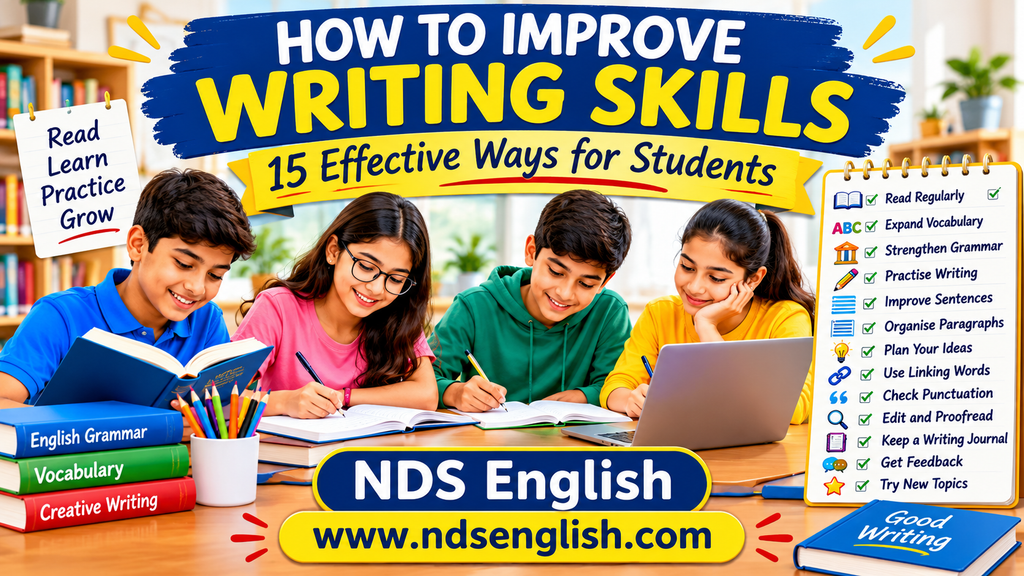
Writing is an essential form of communication that enables individuals to express ideas, convey information, present arguments and share experiences. Whether a student is preparing an academic assignment, composing an essay, writing a story or communicating through email, the ability to write effectively is valuable in both academic and professional life.
However, good writing involves much more than arranging words into sentences. It requires a clear understanding of grammar, appropriate vocabulary, logical organisation and the ability to communicate ideas meaningfully. Many students understand a subject but struggle to express their knowledge in writing. Others find it difficult to develop paragraphs, construct grammatically accurate sentences or select suitable words.
Writing proficiency develops through continuous learning and purposeful practice. The following fifteen strategies can help students strengthen their writing abilities and become more confident communicators.
What Are Writing Skills?
Writing skills refer to the ability to communicate thoughts, information, opinions and experiences through written language. Effective writing requires the writer to present ideas clearly, organise information logically and use language appropriate to the purpose and audience.
A well-written composition generally demonstrates the following qualities:
- Clarity: The intended meaning is communicated without unnecessary complexity.
- Accuracy: Grammar, spelling and punctuation are used correctly.
- Coherence: Ideas are connected in a logical sequence.
- Vocabulary: Words are selected according to their meaning and context.
- Organisation: Information is arranged into meaningful sections and paragraphs.
- Originality: Ideas are expressed independently rather than mechanically reproduced.
15 Effective Ways to Improve Writing Skills
1. Develop a Regular Reading Habit
Reading provides valuable exposure to the language. It introduces students to different expressions, sentence patterns, vocabulary and writing techniques.
Read a variety of materials, including short stories, novels, newspapers, biographies and informative articles. Observe how authors introduce subjects, develop arguments and connect paragraphs.
Practice: Read one article daily and identify five unfamiliar words. Understand their meanings and use them in original sentences.
2. Expand Your Vocabulary
A strong vocabulary allows writers to express ideas with greater precision. Repeatedly using familiar words can make writing monotonous.
For example:
- Important – Essential, significant, valuable
- Beautiful – Attractive, graceful, picturesque
- Difficult – Challenging, demanding, complicated
- Happy – Delighted, cheerful, pleased
Remember that similar words may have different contextual meanings. Select vocabulary according to the message you wish to communicate.
3. Strengthen Your Grammar
Grammar provides the structural foundation of written communication. Incorrect grammatical constructions can make even well-developed ideas difficult to understand.
Students should gradually master essential topics such as parts of speech, tenses, subject-verb agreement, articles, prepositions, conjunctions and sentence structures.
For example:
Incorrect: She go to school every morning.
Correct: She goes to school every morning.
Understanding why the second sentence is correct helps students apply the same rule in other situations.
4. Practise Writing Consistently
Regular practice helps learners become familiar with expressing their thoughts independently. Begin with short paragraphs and gradually progress towards longer compositions.
Suitable topics include:
- My Favourite Book
- The Importance of Education
- A Memorable Experience
- The Benefits of Reading
- Environmental Protection
Even fifteen minutes of focused writing each day can establish a productive learning routine.
5. Improve Sentence Construction
Sentences form the foundation of every written composition. Students should learn to construct grammatically correct sentences before experimenting with complex structures.
Consider these examples:
Basic: The children played in the garden.
Intermediate: The children enjoyed playing in the garden because the weather was pleasant.
Advanced: Taking advantage of the pleasant weather, the children spent the afternoon playing happily in the garden.
The objective is not to make every sentence lengthy. Effective writing depends on choosing the structure that communicates an idea most appropriately.
6. Learn to Organise Paragraphs
A paragraph should communicate one central idea supported by relevant information.
A well-structured paragraph generally includes:
- Topic sentence: Introduces the main idea.
- Supporting sentences: Provide explanations, examples or evidence.
- Concluding sentence: Completes the discussion meaningfully.
For instance, a paragraph about education could begin by explaining its importance, develop the idea through examples of personal and social development, and conclude by emphasising its contribution to society.
7. Plan Your Ideas Before Writing
Beginning a composition without preparation can result in repetition, irrelevant information and poorly connected paragraphs.
Before writing, identify the central subject and note down the important points you wish to discuss.
For example, an essay on the importance of technology could cover communication, education, healthcare, employment and potential disadvantages.
Arrange these points in a logical sequence before developing them into paragraphs.
8. Explore Different Forms of Writing
Students should understand that writing serves different purposes. Each form requires a particular approach and style.
- Narrative writing: Presents events or experiences in a story-like sequence.
- Descriptive writing: Uses vivid details to portray a person, place, object, or experience.
- Expository writing: Explains a subject through information and logical development.
- Persuasive writing: Attempts to influence the reader’s opinion.
- Argumentative writing: Examines a viewpoint through reasoning and supporting evidence.
- Creative writing: Uses imagination and original expression to develop literary compositions.
Practising these forms helps students become adaptable writers.
9. Use Linking Expressions Appropriately
Connecting expressions help establish relationships between sentences and paragraphs.
Some useful examples include:
- Addition: Furthermore, moreover, additionally
- Contrast: However, nevertheless, whereas
- Cause and effect: Consequently, therefore, as a result
- Examples: For instance, to illustrate
- Conclusion: In summary, ultimately, in conclusion
These expressions should be used naturally to improve the flow of writing rather than inserted unnecessarily.
10. Avoid Unnecessary Repetition
Repeating words and ideas can weaken a composition. Students should learn to vary their expressions without changing the intended meaning.
For example:
Repetitive: The city was beautiful. The beautiful buildings made the city look beautiful.
Improved: The city was attractive, and its magnificent buildings enhanced its overall appearance.
Precise vocabulary makes writing more engaging and effective.
11. Understand Punctuation Rules
Punctuation helps establish the meaning and structure of written sentences. Incorrect punctuation can create confusion or alter the intended message.
Students should become familiar with full stops, commas, question marks, exclamation marks, apostrophes, quotation marks, colons and semicolons.
For example:
“Let’s eat, children!”
“Let’s eat children!”
The placement of a comma completely changes the meaning. Therefore, punctuation deserves careful attention.
12. Develop Editing and Proofreading Habits
The first draft of a composition rarely represents its final form. Reviewing written work allows students to identify weaknesses and make necessary corrections.
Check for grammatical inaccuracies, spelling errors, inappropriate vocabulary, punctuation mistakes and poorly constructed sentences.
Students should also examine whether every paragraph contributes to the central subject.
13. Maintain a Writing Journal
A personal writing journal provides an opportunity to practise independent expression. Students can record observations, experiences, opinions, interesting vocabulary and creative ideas.
They may also write short reflections about everyday events or describe places they have visited.
This activity gradually improves fluency, observation and the ability to develop original ideas.
14. Learn from Constructive Feedback
Feedback helps students recognise their strengths and understand where improvement is necessary.
Teachers can evaluate written work according to grammar, vocabulary, organisation, relevance, creativity and accuracy.
However, students should not merely memorise corrected versions. They should understand the reasons behind their mistakes and practise rewriting the affected sentences.
15. Challenge Yourself with Unfamiliar Subjects
Writing about familiar subjects is useful, but unfamiliar topics encourage deeper thinking and independent expression.
Consider writing about questions such as:
- Should technology replace traditional classrooms?
- Why is environmental awareness important?
- Does reading influence personal development?
- What responsibilities do young people have towards society?
Such topics encourage students to explain, compare, analyse and support their opinions.
Writing Development at Different Levels
Writing instruction should progress according to a learner’s abilities.
Beginner Level: Focus on basic vocabulary, grammatical accuracy, simple sentences and short paragraphs.
Intermediate Level: Develop paragraph organisation, varied sentence structures, supporting details and appropriate linking expressions.
Advanced Level: Concentrate on sophisticated vocabulary, analytical thinking, stylistic choices, coherent arguments and precise expression.
For example, the topic The Importance of Reading can be approached differently at each stage.
- Beginner: Reading helps us learn new things.
- Intermediate: Reading broadens our knowledge and introduces us to different perspectives.
- Advanced: Reading enriches intellectual development by exposing individuals to diverse perspectives, complex ideas and varied forms of expression.
The progression demonstrates how learners can communicate increasingly developed ideas.
A Seven-Day Writing Practice Schedule
Students can follow this simple weekly programme to establish consistency.
| Day | Writing activity |
| Monday | Write a paragraph about yourself. |
| Tuesday | Describe a favourite place. |
| Wednesday | Compose a short imaginative story. |
| Thursday | Explain the importance of education. |
| Friday | Write an opinion-based composition. |
| Saturday | Review and edit an earlier composition. |
| Sunday | Write independently on an unfamiliar topic. |
Conclusion
Developing effective writing skills requires patience, discipline and continuous learning. A strong writer is not simply someone who knows numerous words or complicated grammatical rules, but someone who can communicate ideas accurately, logically and appropriately.
Students should develop a habit of reading, practise writing regularly, strengthen their grammatical knowledge and learn to evaluate their own work. They should also explore different forms of writing and gradually move towards more demanding subjects.
Every writing exercise offers an opportunity to improve. With consistent effort and thoughtful practice, learners can develop the confidence and competence required to become effective writers.
NDS English – Learn, Practise and Express Yourself with Confidence.