Parts of a Story
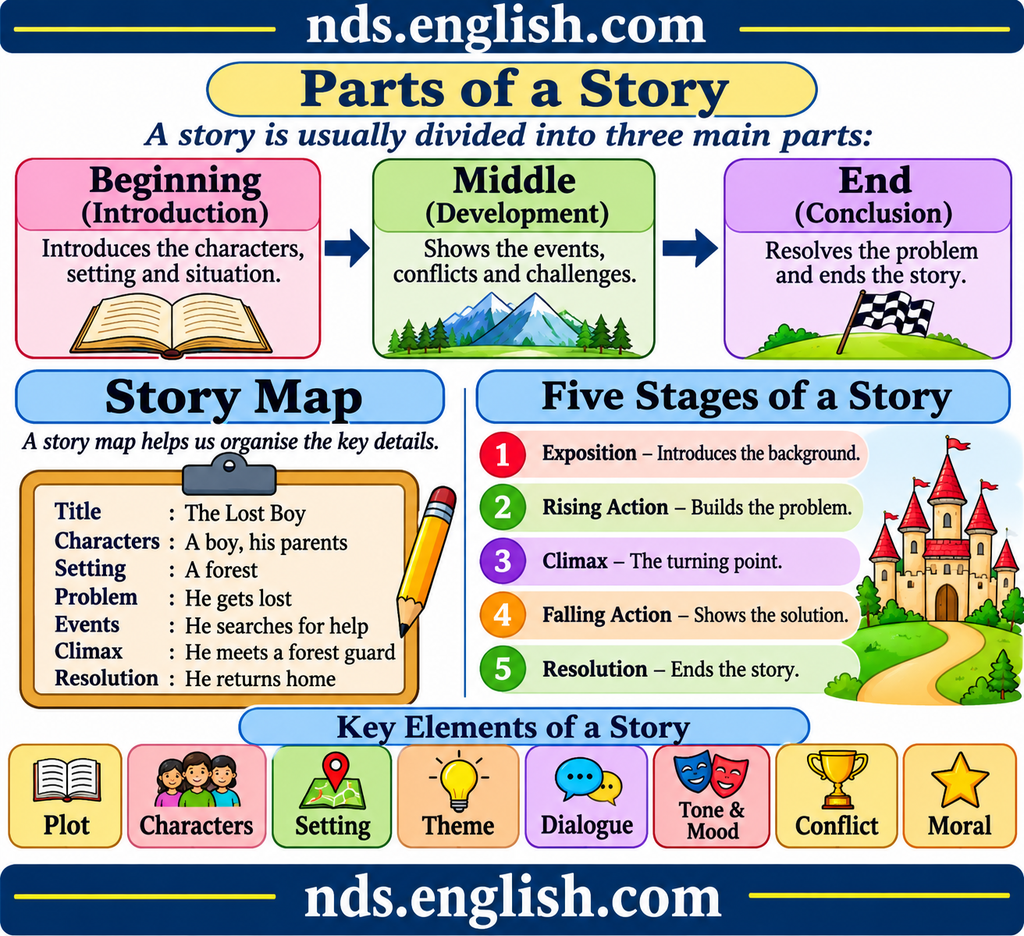
Different Parts of a Story
A story is generally divided into three main parts: the beginning, the middle, and the end. These three sections help organise the events and present them in a logical sequence. Each part has a specific purpose in developing the narrative and keeping the readers interested.
1. Beginning (Introduction)
The beginning is the opening section of a story. It introduces the main characters, establishes the setting, and provides some background information about the situation.
At this stage, readers become familiar with the characters, understand where and when the story takes place, and get an idea of what the narrative is about. The beginning should create curiosity and encourage readers to continue reading.
2. Middle (Development)
The middle is the main section of the story, where the events develop and the characters encounter different situations, difficulties, or challenges.
The central problem or conflict is introduced and gradually becomes more complicated. The characters respond to these situations, make decisions, and take actions that influence the direction of the story.
This section generally contains the most important events and leads towards the climax, which is the major turning point of the narrative.
3. End (Conclusion)
The end is the final section of the story, where the events reach a conclusion. The main problem or conflict is resolved, and readers discover what happens to the characters.
The ending may be happy, sad, unexpected, or open-ended, depending on the writer’s purpose. It may also leave readers with a particular thought, feeling, or message.
Story Map
A story map is a visual or written method of organising the important elements and events of a story. It helps writers and students understand how a story is structured and how its different parts are connected.
A story map usually includes the title, characters, setting, main problem, important events, climax, and resolution.
It serves as a planning tool that allows writers to arrange their ideas before beginning to write. Students can also use it to understand, analyse, and summarise stories they have read.
For example, before writing a story about a young boy who gets lost in a forest, a student can prepare a story map containing the following information:
- Title: The Lost Boy
- Characters: A young boy, his parents, and a forest guard.
- Setting: A forest near a village.
- Problem: The boy gets separated from his parents.
- Main Events: He searches for a way out, encounters difficulties, and tries to find help.
- Climax: He meets a forest guard who recognises him.
- Resolution: The forest guard helps him reunite with his parents.
Thus, a story map provides a clear outline of the narrative and makes the writing process more organised.
Plot of a Story:
The plot of a story refers to the arrangement and development of events that form the main narrative. It explains what happens in the story, how one event leads to another, what challenges the characters face, and how the situation eventually reaches a conclusion.
The plot gives direction to the story by connecting different incidents in a meaningful sequence. It also creates interest by introducing problems, unexpected developments, and important turning points.
For example, consider a story about a young girl who wants to become a scientist. The plot may begin with her interest in science, develop through the difficulties she faces while pursuing her education, reach an important turning point when she wins a science competition, and conclude with her achieving her dream.
A well-developed plot keeps readers interested because they want to discover what happens next and how the characters deal with their situations.
Stages of a Story:
Although a story has three broad sections—beginning, middle, and end—it can be divided further into five important stages to explain how the narrative develops.
The five stages are:
1. Exposition
Exposition is the introductory stage of a story. It provides the basic information readers need to understand the narrative.
At this stage, the writer introduces the main characters, the setting, and the background of the situation. Readers become familiar with the circumstances in which the story begins.
Example: A story begins by introducing a young boy named Arjun who lives with his parents in a small village near a forest.
2. Rising Action
Rising action refers to the series of events that develop the main problem or conflict. During this stage, the characters encounter difficulties, unexpected situations, and challenges.
Each new incident adds to the development of the narrative and increases the readers’ curiosity about what might happen next.
Example: Arjun enters the forest to collect flowers but loses his way. As evening approaches, he becomes increasingly worried because he cannot find the path back home.
3. Climax
The major turning point in the plot is the most exciting and significant moment in a story, that is the climax. It is the stage where the main conflict reaches its higheThe climax is the most important and exciting turning point in a story.
An important event, discovery, or decision takes place that influences the direction of the remaining narrative.
Example: Just when Arjun begins to lose hope of finding his way home, he notices a forest guard approaching on a bicycle.
4. Falling Action
Falling action refers to the events that take place immediately after the climax. At this stage, the tension gradually decreases, and the consequences of the major turning point become clearer.
The characters begin moving towards a solution, and the remaining complications are gradually settled.
Example: The forest guard speaks to Arjun, discovers where he lives, and decides to help him return to his village.
5. Resolution (Denouement)
Resolution is the final stage of the narrative, where the main conflict reaches its conclusion. The remaining questions are answered, and readers discover how the characters’ situations have changed.
Depending on the writer’s intention, the story may have a happy, sad, surprising, or open-ended conclusion.
Example: The forest guard safely takes Arjun back to his parents. His family is relieved to see him, and Arjun learns an important lesson about being careful while exploring unfamiliar places.