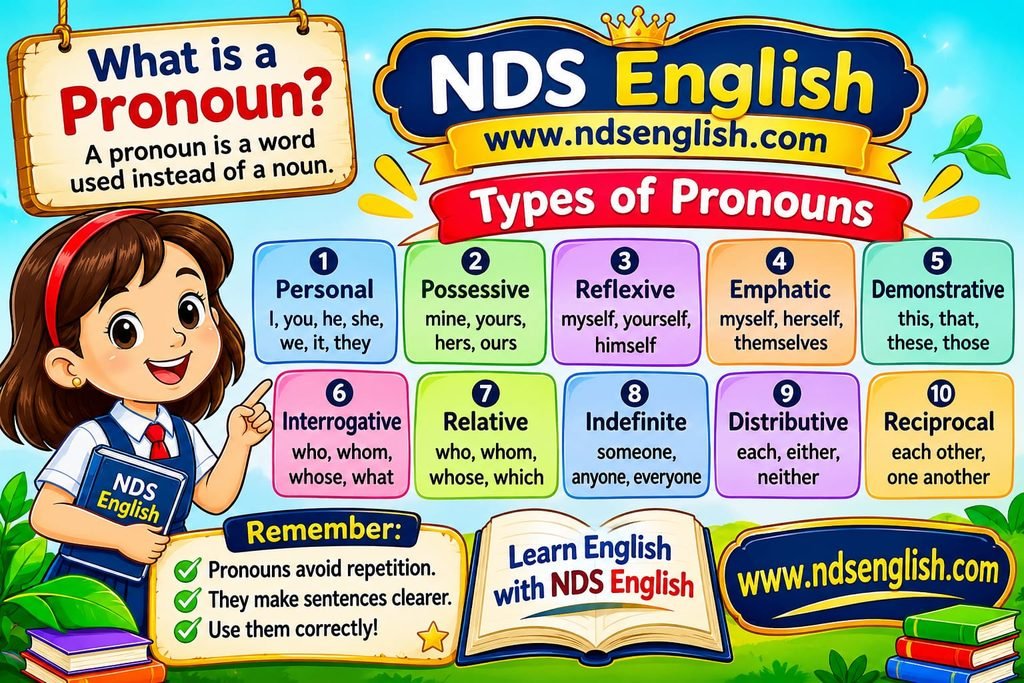
1. What Is a Pronoun?
A pronoun is a word that replaces a noun when referring to a person, animal, place, or thing. It helps prevent unnecessary repetition and makes communication smoother and more effective.
Example:
Without pronouns:
Meera is a brilliant student. Meera attends her classes regularly. Meera always completes Meera’s homework on time.
With pronouns:
Meera is a brilliant student. She attends her classes regularly. She always completes her homework on time.
In the second example, the pronoun she replaces the noun Meera, while her indicates possession.
Some frequently used pronouns include I, you, he, she, it, we, they, me, him, her, us and them.
2. Different Types of Pronouns
In traditional school grammar, pronouns are generally divided into ten main categories. Each category has a particular purpose in sentence construction.
1. Personal Pronouns
Personal pronouns are words used to refer to specific people, animals, or things. Their forms change depending on who is speaking, who is being addressed and who or what is being discussed.
Examples: I, we, you, he, she, it, they, me, us, him, her and them.
Sentences:
- We are preparing for the annual examination.
- He enjoys reading adventure stories.
- She teaches English to young learners.
- They visited the museum last Sunday.
- The coach selected him for the team.
Personal pronouns are divided into three grammatical persons:
- First Person: The speaker or speakers – I, we.
- Second Person:Refers to the person or people being addressed – you.
- Third Person: The person, animal or thing being discussed – he, she, it, they.
Personal pronouns can also be classified according to their position in a sentence:
- Subject Pronouns: Pronouns used as the subject of a sentence – I, we, you, he, she, it, and they.
- Object Pronouns: Me, us, you, him, her, it, them.
2. Possessive Pronouns
Possessive pronouns express ownership. They help us identify the person to whom something belongs without repeating the name of the object or person.
Examples: Mine, yours, his, hers, ours and theirs.
Sentences:
- The red umbrella is mine.
- This garden is ours.
- That notebook is hers.
- The responsibility is yours.
- The victory was theirs.
Important distinction:
Possessive pronouns should not be confused with possessive determiners.
- This is my pen. (My is a possessive determiner.)
- This pen is mine. (Mine is a possessive pronoun.)
3. Reflexive Pronouns
Reflexive pronouns are used when the subject performs an action on itself. They show that the action is directed back towards the subject.
Most reflexive pronouns end in -self or -selves.
Examples: Themselves, ourselves, itself, herself, himself, yourselves, yourself, and myself.
Sentences:
- I taught myself how to paint.
- She prepared herself for the interview.
- The boy accidentally injured himself.
- We introduced ourselves to the new teacher.
- The children entertained themselves during the journey.
4. Emphatic Pronouns
Emphatic pronouns are used to give additional importance to the subject of a sentence. They have exactly the same forms as reflexive pronouns, but their purpose is different.
Examples: Themselves, ourselves, itself, herself, himself, yourselves, yourself, and myself.
Sentences:
- The director himself welcomed the guests.
- I myself checked every answer.
- The teacher herself explained the difficult chapter.
- The players themselves arranged the equipment.
Difference between Reflexive and Emphatic Pronouns:
A reflexive pronoun is used to complete a sentence when the action performed by the subject is directed back at the subject. An emphatic pronoun merely highlights the subject and can generally be removed without changing the basic meaning.
Examples:
- She blamed herself for the mistake. (Reflexive)
- She herself completed the entire project. (Emphatic)
5. Demonstrative Pronouns
Demonstrative pronouns identify or point out particular people, animals or objects. They indicate whether something is near or far and whether it is singular or plural.
There are four principal demonstrative pronouns:
- This: Refers to a single person or thing that is close by.
- That: Used for one person or thing situated farther away.
- These: Used for several people or things that are nearby.
- Those: Used for several people or things situated farther away.
Sentences:
- This is the painting I created.
- That belongs to my younger brother.
- These are the photographs from our school trip.
- Those are the mountains we saw yesterday.
6. Interrogative Pronouns
Interrogative pronouns are words that help us frame questions. They are used to ask about the identity of a person, the nature of something, a particular choice or ownership.
Examples: Who, whom, whose, which and what.
Sentences:
- Who is responsible for this project?
- Whom did you meet at the station?
- Whose is this dictionary?
- Which is your favourite story?
- What caused the delay?
7. Relative Pronouns
Relative pronouns are words that link a noun or pronoun to a clause that provides additional information about it.
They help combine related ideas within a sentence.
Examples: Who, whom, whose, which and that.
Sentences:
- The girl who secured the first position is my neighbour.
- The gentleman whom we invited is a famous writer.
- I know a student whose mother is a doctor.
- The laptop which I purchased last month works perfectly.
- The horse that won the race belongs to my uncle.
8. Indefinite Pronouns
Indefinite pronouns refer to people, animals or objects without mentioning their exact identities. They are useful when the speaker does not know, or does not need to specify, the particular person or thing.
Examples: Somebody, someone, anybody, anyone, everybody, everyone, nobody, no one, something, anything, everything, nothing, few, many, several and all.
Sentences:
- Someone has taken my water bottle.
- Everyone appreciated the performance.
- Nobody was able to solve the puzzle.
- Several attended the educational workshop.
- Everything has been arranged for the celebration.
9. Distributive Pronouns
Distributive pronouns refer to individuals within a group separately rather than treating the group as a single unit. They are used to refer to people or things individually, one at a time.
Examples: Each, either and neither.
Sentences:
- Each of the children received a gift.
- Either of these two routes will take you to the station.
- Neither of the candidates was selected.
- Each of the players has a separate responsibility.
Remember: In standard formal grammar, each, either and neither generally take a singular verb when used as pronouns.
10. Reciprocal Pronouns
Reciprocal pronouns show that two or more people carry out an action towards each other. They express mutual feelings, actions or relationships.
There are two reciprocal pronouns:
- Each other
- One another
Sentences:
- The two sisters share their experiences with each other.
- The team members encouraged one another.
- The neighbours helped each other during the emergency.
- Good friends should always respect one another.
3. Essential Rules for Using Pronouns Correctly
Understanding the different categories of pronouns is important, but knowing how to use them correctly is equally necessary.
Rule 1: A pronoun should agree with the noun it represents.
The pronoun should agree with its antecedent in both person and number.
Example: Rohan is a hardworking boy. He completes his assignments regularly.
Rule 2: Use subject pronouns to indicate who or what performs the action in a sentence.
Subject pronouns act as the subject of a sentence or identify the person or thing being discussed.
Example: She and I participated in the competition.
Rule 3: Use object pronouns after verbs and prepositions.
Object pronouns receive the action of a verb or follow a preposition.
Example: The teacher appreciated her.
Rule 4: Use reflexive pronouns when the subject and object refer to the same person or thing.
Example: The child dressed himself.
Rule 5: Do not confuse possessive pronouns with possessive determiners.
Possessive determiners come before nouns, whereas possessive pronouns can stand independently.
Example:
- This is their classroom.
- This classroom is theirs.
Rule 6: Understand the difference between who and whom.
Who generally functions as the subject, whereas whom functions as the object in formal English.
Examples:
- Who prepared this presentation?
- Whom did you invite to the function?
4. Quick Revision: Types of Pronouns
| Type | Examples |
| Personal | I, we, you, he, she, they |
| Possessive | Mine, yours, his, hers, ours |
| Reflexive | Myself, herself, ourselves |
| Emphatic | Himself, herself, themselves |
| Demonstrative | This, that, these, those |
| Interrogative | Who, whom, whose, which, what |
| Relative | Who, whom, whose, which, that |
| Indefinite | Someone, anybody, everyone |
| Distributive | Each, either, neither |
| Reciprocal | Each other, one another |
Conclusion
Pronouns play an important role in English grammar because they allow us to express ideas without repeatedly mentioning the same nouns. They make sentences more organised, natural and easier to understand.
Learning the different categories of pronouns, recognising their functions and applying the correct grammatical rules can strengthen a student’s command of English. Regular practice also helps develop better sentence construction, reading comprehension and written communication.
Pronouns: Practice Exercises
Test your understanding of pronouns through the following activities. Read each sentence carefully and identify the correct pronoun or grammatical category.
Question 1: Identify the Type of Pronoun
Read the sentences and write the category of the highlighted pronoun.
- She has enrolled in an advanced English course.
- This is the most interesting chapter in the book.
- Somebody has placed a parcel outside the gate.
- The children enjoyed themselves during the school trip.
- The two cousins always encourage each other.
- Whose is this attractive handbag?
- Each of the competitors received a medal.
- The boy who secured the highest marks is my nephew.
- The new laptop is mine.
- The headmistress herself announced the results.
Question 2: Complete the Sentences with Appropriate Pronouns
Choose a suitable pronoun to complete each statement.
- Arjun is my cousin. ______ studies in Class 8.
- This dictionary belongs to me. It is ______.
- The players organised the event by ______.
- ______ is responsible for decorating the classroom?
- The two brothers always stand by ______.
- ______ are the photographs taken during our holiday.
- Nobody knows ______ caused the problem.
- The lady ______ works in the library is very helpful.
- ______ of the two suggestions would you prefer?
- I completed the entire assignment ______.
Question 3: Select the Correct Option
Choose the grammatically appropriate word from the brackets.
- (He/Him) is the captain of our team.
- The librarian advised (we/us) to maintain silence.
- This responsibility belongs to (they/them).
- (Who/Whom) is speaking to the principal?
- The girls prepared (theirselves/themselves) for the performance.
- (This/These) are the notebooks I need.
- The woman (who/which) teaches us mathematics is very kind.
- Neither of the two answers (is/are) acceptable.
- The final decision is (my/mine).
- The two teammates always encourage (each other/themselves).
Question 4: Find the Pronouns and Explain Their Functions
Identify the pronoun in each sentence and mention its grammatical category.
- I completed the presentation myself.
- Those are the books required for the examination.
- Everyone enjoyed the cultural programme.
- Whom did you invite to the meeting?
- The student who solved the problem received a special award.
Question 5: Rewrite the Sentences by Replacing Repeated Nouns with Pronouns
Combine or rewrite the following sentences to avoid unnecessary repetition.
- Kavya is an excellent dancer. Kavya performs at several cultural events.
- The children are decorating the hall. The children are preparing for the celebration.
- My father bought a new watch. My father gifted the watch to me.
- Aman and Aditya are classmates. Aman and Aditya attend the same tuition centre.
- The kitten is thirsty. The kitten is searching for water.
Question 6: Construct Your Own Sentences
Write one meaningful and grammatically correct sentence using each of the following pronouns.
- Somebody
- Ourselves
- Neither
- Whose
- Those
Answer Key
Check your responses after completing all the exercises.
Answers to Question 1
- She – Personal Pronoun.
- This – Demonstrative Pronoun.
- Somebody – Indefinite Pronoun.
- Themselves – Reflexive Pronoun.
- Each other – Reciprocal Pronoun.
- Whose – Interrogative Pronoun.
- Each – Distributive Pronoun.
- Who – Relative Pronoun.
- Mine – Possessive Pronoun.
- Herself – Emphatic Pronoun.
Answers to Question 2
- He.
- Mine.
- Themselves.
- Who.
- Each other.
- These.
- What.
- Who.
- Which.
- Myself.
Answers to Question 3
- He.
- Us.
- Them.
- Who.
- Themselves.
- These.
- Who.
- Is.
- Mine.
- Each other.
Answers to Question 4
- Myself – Emphatic Pronoun. It highlights that the speaker personally completed the presentation.
- Those – Demonstrative Pronoun. It identifies particular books.
- Everyone – Indefinite Pronoun. It refers to all the people in a group without naming them individually.
- Whom – Interrogative Pronoun. It is used to ask about the person who received the action.
- Who – Relative Pronoun. It introduces additional information about the student.
Answers to Question 5
- Kavya is an excellent dancer. She performs at several cultural events.
- The children are decorating the hall. They are preparing for the celebration.
- My father bought a new watch. He gifted it to me.
- Aman and Aditya are classmates. They attend the same tuition centre.
- The kitten is thirsty. It is searching for water.
Answers to Question 6
Sample answers:
- Somebody – Somebody has left a notebook in the classroom.
- Ourselves – We prepared the entire presentation ourselves.
- Neither – Neither of the two dresses suits me.
- Whose – Whose bag is lying near the entrance?
- Those – Those are the paintings displayed in the gallery.
Note: The answers to Question 6 may differ from student to student. Any suitable sentence that uses the given pronoun correctly should be accepted.