Parts of Speech in English Grammar: Meaning, Types, Rules, Examples and Exercises
Introduction
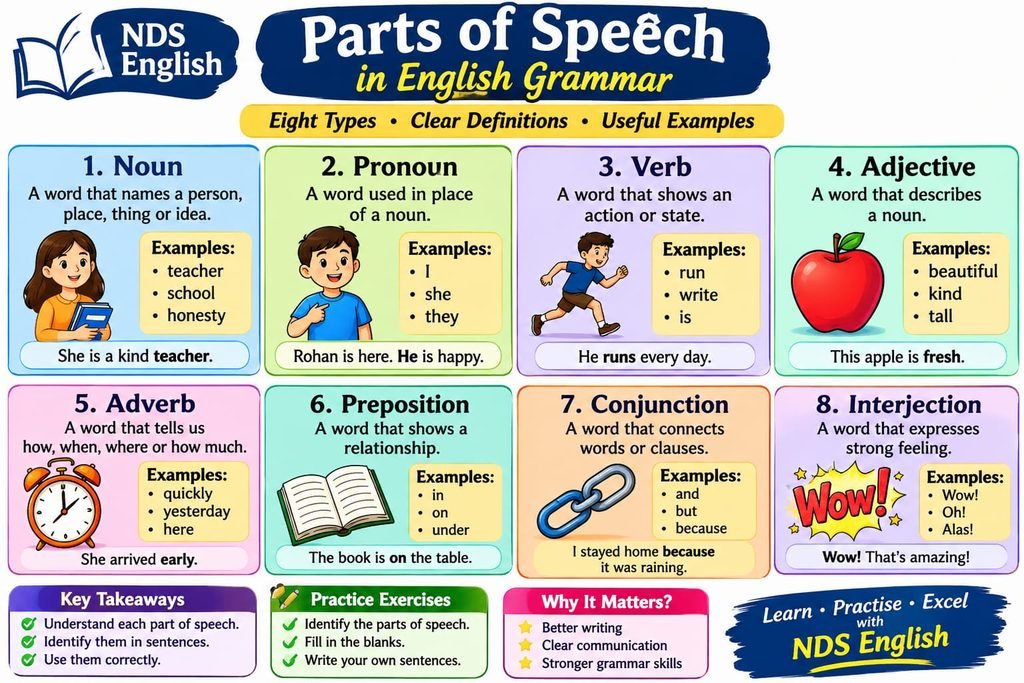
English grammar is built upon several fundamental elements that help us communicate our thoughts, express our feelings, and convey information accurately. Among these elements, parts of speech hold a significant position because they explain how different words function within a sentence. Every English sentence consists of words arranged in a particular order. However, words do not all perform the same function. Some words identify people, places, or objects, while others describe actions, express qualities, or establish relationships between different elements of a sentence.
Words are grouped based on the grammatical roles they perform in a sentence, and these groups are called parts of speech. Understanding the eight traditional parts of speech is essential for developing grammatical accuracy, improving sentence construction, and communicating effectively in both written and spoken English.
Let us examine each part of speech individually, with definitions, examples, and practical applications.
What Are Parts of Speech?
Parts of speech are the categories into which words are classified according to the roles they perform in a sentence.
In traditional English grammar, words are divided into eight major categories:
- Noun
- Pronoun
- Verb
- Adjective
- Adverb
- Preposition
- Conjunction
- Interjection
Each category serves a distinct grammatical purpose. Together, they provide the structure necessary for forming meaningful sentences.
1. Noun
Definition
A noun is a word that names a person, place, animal, thing, quality, emotion, or idea. Nouns help us identify the subjects and objects we discuss in everyday communication.
Examples
- Person: Teacher, doctor, student, mother.
- Place: Kolkata, school, hospital, village.
- Animal: Elephant, tiger, horse, rabbit.
- Object: Table, computer, pencil, telephone.
- Quality: Honesty, kindness, bravery.
- Feeling: Happiness, sadness, excitement.
- Idea: Freedom, knowledge, justice.
Types of Nouns
1. Proper Noun
A proper noun identifies a particular person, place, organisation, or specific entity. It begins with a capital letter.
Examples: India, Kolkata, Shakespeare, Monday.
Sentence: India is a nation known for its rich cultural heritage.
2. Common Noun
A common noun refers to a general person, place, animal, or object rather than a particular one.
Examples: Boy, city, river, school, book.
Sentence: The boy is reading a book.
3. Collective Noun
A collective noun represents a group of people, animals, or things considered as a unit.
Examples: Team, audience, committee, flock, army.
Sentence: The committee has announced its decision.
4. Abstract Noun
An abstract noun refers to an idea, quality, emotion, or condition that cannot be experienced through the five physical senses.
Examples: Love, courage, honesty, wisdom, childhood.
Sentence: Honesty is an important quality in a person’s character.
5. Material Noun
A material noun identifies a substance or material from which objects are made.
Examples: Gold, silver, cotton, wood, iron.
Sentence: The necklace is made of gold.
Functions of Nouns in Sentences
Nouns can perform different grammatical functions.
- Subject: The teacher explained the lesson.
- Direct object: She purchased a dictionary.
- Indirect object: The teacher gave the students an assignment.
- Object of a Preposition: The children are enjoying themselves while playing in the park.
2. Pronoun
Definition
A pronoun is a word used in place of a noun to avoid unnecessary repetition and make sentences more natural.
Pronouns help maintain clarity and continuity in communication.
Examples
I, we, you, he, she, it, they, me, him, her, us, them.
Without pronouns: Riya is a student. Riya studies English. Riya enjoys reading.
With pronouns: Riya is a student. She studies English and enjoys reading.
Types of Pronouns
1. Personal Pronouns
These pronouns refer to particular people or things.
Examples: I, we, you, he, she, it, they.
Sentence: They are preparing for the examination.
2. Possessive Pronouns
These pronouns indicate ownership or possession.
Examples: Mine, ours, yours, his, hers, theirs.
Sentence: This notebook is mine.
3. Reflexive Pronouns
These pronouns refer back to the subject of the sentence.
Examples: Myself, yourself, himself, herself, itself, ourselves, themselves.
Sentence: She prepared the entire presentation herself.
4. Demonstrative Pronouns
These pronouns point towards particular people or things.
Examples: This, that, these, those.
Sentence: These are the books I purchased yesterday.
5. Interrogative Pronouns
These pronouns are used to ask questions.
Examples: Who, whom, whose, which, what.
Sentence: Who is responsible for organising the event?
6. Relative Pronouns
These pronouns uses relative clauses and connect additional information to a noun.
Examples: Who, whom, whose, which, that.
Sentence: The woman who teaches us English is highly experienced.
7. Indefinite Pronouns
These pronouns refer to people or things without identifying them specifically.
Examples: Someone, anyone, everybody, nobody, something, everything.
Sentence: Everybody should respect the opinions of others.
8. Distributive Pronouns
These pronouns refer to members of a group individually.
Examples: Each, either, neither.
Sentence: Each of the participants received a certificate.
3. Verb
Definition
A verb is a word that expresses an action, occurrence, or state of being.
Verbs are essential components of sentences because they communicate what the subject does, experiences, or is.
Examples
Run, write, speak, dance, think, understand, become, is, am, are.
Types of Verbs
1. Action Verbs
Action verbs express physical or mental activities.
Examples: Run, jump, read, write, imagine, believe.
Sentences:
- The children play football every evening.
- She understands the importance of education.
2. Linking Verbs
Linking verbs join the subject to a word or phrase that explains its identity or describes its qualities.
Examples: Is, am, are, was, were, become, seem, appear.
Sentence: The classroom is quiet.
Here, the verb ‘is’ connects the subject ‘classroom’ with the description ‘quiet’.
3. Helping Verbs (Auxiliary Verbs)
Helping verbs work with main verbs to form different tenses, questions, negatives, and other grammatical structures.
Examples: Is, am, are, was, were, has, have, had, do, does, did.
Sentence: She is preparing for her examination.
In this sentence, ‘is’ functions as the auxiliary verb, while ‘preparing’ acts as the main verb.
4. Modal Verbs
Modal verbs indicate ability, possibility, permission, necessity, or recommendation.
Examples: Can, could, may, might, must, shall, should, will, would.
Sentences:
- You should respect your teachers.
- Students must follow the examination instructions.
- She can speak three languages.
5. Transitive Verbs
A transitive verb requires a direct object to complete its meaning.
Sentence: The teacher explained the lesson.
Here, ‘explained’ is the verb, and ‘the lesson’ is its direct object.
6. Intransitive Verbs
An intransitive verb does not require a direct object.
Sentence: The baby slept peacefully.
Here, ‘slept’ does not require a direct object.
4. Adjective
Definition
An adjective is a word that describes or modifies a noun or pronoun by giving more details about its qualities, features, number, or nature. Adjectives make descriptions more precise and meaningful.
Examples
Beautiful, intelligent, tall, honest, several, five, little, enormous.
Types of Adjectives
1. Adjectives of Quality
These adjectives describe the qualities or features of a person, place, or thing.
Examples: Beautiful, intelligent, courageous, honest.
Sentence: She is an intelligent student.
2. Adjectives of Quantity
These indicate the amount of something, generally without specifying an exact number.
Examples: Some, much, little, sufficient, enough.
Sentence: There is sufficient water in the tank.
3. Adjectives of Number
These indicate the number or order of people or things.
Examples: One, two, five, first, second, several.
Sentence: Five students participated in the competition.
4. Demonstrative Adjectives
These identify particular nouns.
Examples: This, that, these, those.
Sentence: Those flowers are beautiful.
5. Possessive Adjectives
These indicate ownership or association.
Examples: My, your, his, her, its, our, their.
Sentence: My brother is a doctor.
6. Interrogative Adjectives
These are used with nouns to ask questions.
Examples: Which, what, whose.
Sentence: Which subject do you prefer?
7. Distributive Adjectives
These refer to members of a group individually.
Examples: Each, every, either, neither.
Sentence: Every student must complete the assignment.
5. Adverb
Definition
An adverb is a word that modifies a verb, an adjective, or another adverb. It provides additional information about how, when, where, or to what extent an action or quality occurs.
Adverbs help us express details more accurately.
Examples
Quickly, carefully, yesterday, here, everywhere, extremely, rarely, always.
Types of Adverbs
1. Adverbs of Manner
These explain how an action is performed.
Examples: Carefully, slowly, politely, beautifully.
Sentence: The student answered the question confidently.
2. Adverbs of Time
These indicate when an action takes place.
Examples: Yesterday, today, tomorrow, soon, recently.
Sentence: We visited the museum yesterday.
3. Adverbs of Place
These indicate where an action occurs.
Examples: Here, there, everywhere, outside, upstairs.
Sentence: The children are playing outside.
4. Adverbs of Frequency
These indicate how often an action takes place.
Examples: Always, usually, often, sometimes, rarely, never.
Sentence: She regularly practises spoken English.
5. Adverbs of Degree
These indicate the degree or intensity of an action, an adjective, or another adverb.
Examples: Very, extremely, quite, almost, too, completely.
Sentence: The examination was extremely difficult.
6. Interrogative Adverbs
These are used to ask questions about time, place, reason, or manner.
Examples: When, where, why, how.
Sentences:
- When will the programme begin?
- Why are you upset?
- How did you complete the assignment?
6. Preposition
Definition
A preposition is a word that shows the connection between a noun or pronoun and other words in a sentence.
Prepositions commonly indicate relationships involving location, time, direction, position, and movement.
Examples
In, on, at, under, over, between, among, beside, behind, through, across, towards.
Types of Prepositions
1. Prepositions of Place
These indicate the position or location of someone or something.
Examples: In, on, under, behind, beside, between.
Sentences:
- The keys are on the table.
- The cat is under the chair.
- The school is beside the hospital.
2. Prepositions of Time
These indicate when an event takes place.
Examples: At, on, in, before, after, during.
Sentences:
- The class begins at 9 a.m.
- My birthday is in November.
- We have a meeting on Monday.
3. Prepositions of Direction
These indicate movement towards a particular place or destination.
Examples: To, towards, into, onto, through, across.
Sentences:
- She walked towards the entrance.
- The boy jumped into the swimming pool.
- They travelled across the country.
4. Prepositions of Agent and Instrument
These indicate the person performing an action or the instrument used to perform it.
Examples: By, with.
Sentences:
- The novel was written by the author.
- She cut the paper with scissors.
7. Conjunction
Definition
A conjunction is a word used to join words, phrases, clauses, or complete sentences.
Conjunctions help establish relationships between different ideas and make communication more organised.
Examples
And, but, or, because, although, since, unless, while, either, neither.
Types of Conjunctions
1. Coordinating Conjunctions
These connect grammatical elements of equal importance.
The seven commonly recognised coordinating conjunctions are:
For, And, Nor, But, Or, Yet, So.
An easy way to remember them is FANBOYS.
Examples:
- She is intelligent and hardworking.
- I wanted to attend the programme, but I was unwell.
- You can read a book or watch a documentary.
2. Subordinating Conjunctions
These introduce dependent clauses and establish relationships such as reason, condition, time, and contrast.
Examples: Because, although, since, if, unless, while, when, before, after.
Sentences:
- We stayed indoors because it was raining.
- Although she was tired, she completed her work.
- You will succeed if you remain consistent.
3. Correlative Conjunctions
These conjunctions are used in pairs to link related words, phrases, or clauses in a sentence.
Examples:
- Either…or
- Neither…nor
- Both…and
- Not only…but also
- Whether…or
Sentences:
- Either Riya or Priya will represent the school.
- Both the student and the teacher attended the meeting.
- He is not only intelligent but also hardworking.
8. Interjection
Definition
An interjection is a word or brief expression that conveys a sudden feeling, emotion, or reaction. It usually stands apart from the grammatical structure of a sentence and is commonly used in everyday conversations and expressive forms of writing.
Examples
Wow! Oh! Alas! Hurrah! Ouch! Bravo! Hurray!
Types of Interjections
1. Interjections of Joy
Examples: Hurrah! Hurray!
Sentence: Hurrah! We have won the competition.
2. Interjections of Surprise
Examples: Wow! Oh! What!
Sentence: Wow! What a remarkable performance!
3. Interjections of Sorrow
Examples: Alas! Oh no!
Sentence: Alas! We have lost a valuable opportunity.
4. Interjections of Approval
Examples: Bravo! Excellent!
Sentence: Bravo! You delivered an impressive speech.
5. Interjections of Pain
Examples: Ouch! Ah!
Sentence: Ouch! That was painful.
Important Differences Between Parts of Speech
Some words can belong to different parts of speech depending on how they are used in a sentence.
Therefore, identifying a word solely by its spelling is not sufficient. Its grammatical function must also be examined.
Consider the following examples:
Example 1: Fast
- Adjective: He drives a fast car. Here ‘fast’ describes the noun ‘car’
- Adverb: He drives fast. It modifies the verb ‘drives’.
Example 2: Light
- Noun: The light is very bright.
- Adjective: She purchased a light suitcase.
- Verb: Please light the candle.
Example 3: Before
- Preposition: We arrived before noon.
- Conjunction: Finish your homework before you go outside.
- Adverb: I have seen this film before.
Example 4: Well
- Adjective: She is well now.
- Adverb: She speaks English well.
- Noun: The villagers gathered near the well.
These examples demonstrate that grammatical classification depends on the function of a word within a particular sentence.
Common Mistakes in Identifying Parts of Speech
English learners sometimes confuse different grammatical categories because certain words have similar forms or meanings.
The following examples illustrate common mistakes.
1. Confusing adjectives with adverbs
Incorrect: She sings beautiful.
Correct: She sings beautifully.
Explanation: ‘Beautifully’ modifies the verb ‘sings’ and is therefore an adverb.
2. Confusing pronouns with possessive adjectives
Example:
- This is my book.
- This book is mine.
‘My’ functions as a possessive adjective because it describes the noun ‘book’. In contrast, ‘mine’ is a possessive pronoun because it takes the place of the noun phrase.
3. Confusing conjunctions with prepositions
Example:
- We waited until evening.
- We waited until the programme ended.
Explanation: ‘Until’ is a preposition in the first sentence because it is followed by the noun ‘evening’. It is a subordinating conjunction in the second because it introduces the clause ‘the programme ended’.
4. Identifying a word without considering its function
Example:
- I like swimming. (Noun or gerund)
- They are swimming. (Verb)
Explanation: The same word can perform different grammatical functions depending on its context.
Why Are Parts of Speech Important?
Learning parts of speech provides a strong foundation for understanding English grammar.
Their importance can be explained through the following points:
- Improved sentence construction: Understanding grammatical categories helps learners arrange words correctly.
- Better writing skills: Knowledge of adjectives, adverbs, and conjunctions improves the clarity and quality of written expression.
- Accurate communication: Recognising grammatical functions reduces errors in spoken and written English.
- Stronger vocabulary: Learners understand how words can be used in different contexts.
- Better comprehension: Knowledge of parts of speech makes it easier to understand complex sentences and written passages.
- Advanced grammar learning: Topics such as clauses, phrases, tenses, and sentence structures become easier to understand.
Conclusion
Parts of speech are the basic building blocks of English grammar. Each category performs a specific function and contributes to the construction of meaningful sentences.
From nouns that identify people and objects to verbs that express actions, adjectives that describe qualities, and conjunctions that connect ideas, every grammatical category has an important role in communication.
Learners should not limit their understanding to memorising definitions and examples. They should also practise identifying the grammatical functions of words in different sentences.
A clear understanding of the eight parts of speech will help students develop stronger grammar skills, construct accurate sentences, and communicate their ideas with greater confidence.
Practice Exercises: Parts of Speech
Test your understanding of the eight parts of speech through the following exercises.
Exercise 1: Identify the Parts of Speech
Determine the part of speech of the bold word in each sentence.
- The teacher explained the lesson.
- She is preparing for the competition.
- The children played in the garden.
- It was a wonderful experience.
- He completed the assignment carefully.
- The book is under the table.
- I wanted to go, but it was raining.
- Hurrah! We have won the match.
- The honesty of the employee impressed everyone.
- She speaks politely to everyone.
Exercise 2: Fill in the Blanks
Choose the appropriate word to complete each sentence.
- Rohan is a ______ boy. (intelligent/intelligently)
- The baby is sleeping ______. (peaceful/peacefully)
- The book is ______ the table. (on/and)
- I stayed at home ______ I was unwell. (because/but)
- ______ is my best friend. (She/Her)
- The children ______ playing in the park. (are/is)
- ______! What a beautiful painting! (Wow/Under)
- We have ______ students in our classroom. (forty/beautifully)
Exercise 3: Classify the Underlined Words
Determine the parts of speech of the underlined words.
- She bought a beautiful dress.
- We will meet tomorrow.
- The children are playing outside.
- Although he was tired, he continued working.
- The cat jumped over the wall.
- Someone has left a bag here.
- The team celebrated its victory.
- Please close the door.
Exercise 4: Identify Different Uses of the Same Word
Identify the parts of speech of the bold words.
- She bought a light bag.
- Please switch on the light.
- They light the candles every evening.
- He runs fast.
- It is a fast train.
- I have met him before.
- We arrived before sunset.
Exercise 5: Write Your Own Sentences
Construct one original sentence using each of the following:
- A proper noun.
- A personal pronoun.
- An action verb.
- An adjective of quality.
- An adverb of manner.
- A preposition of place.
- A coordinating conjunction.
- An interjection expressing surprise.
Answer Key
Exercise 1
- Teacher – Noun.
- She – Pronoun.
- Played – Verb.
- Wonderful – Adjective.
- Carefully – Adverb.
- Under – Preposition.
- But – Conjunction.
- Hurrah – Interjection.
- Honesty – Noun.
- Politely – Adverb.
Exercise 2
- Intelligent.
- Peacefully.
- On.
- Because.
- She.
- Are.
- Wow.
- Forty.
Exercise 3
- Beautiful – Adjective.
- Tomorrow – Adverb.
- Outside – Adverb.
- Although – Conjunction.
- Over – Preposition.
- Someone – Pronoun.
- Team – Noun.
- Close – Verb.
Exercise 4
- Light – Adjective.
- Light – Noun.
- Light – Verb.
- Fast – Adverb.
- Fast – Adjective.
- Before – Adverb.
- Before – Preposition.
Exercise 5
Answers will vary. Students should construct grammatically correct sentences using the specified parts of speech.
Learning Tip: Practise identifying parts of speech by examining complete sentences rather than memorising individual words. This approach will help you understand how English grammar functions in real communication.