Introduction to English Grammar
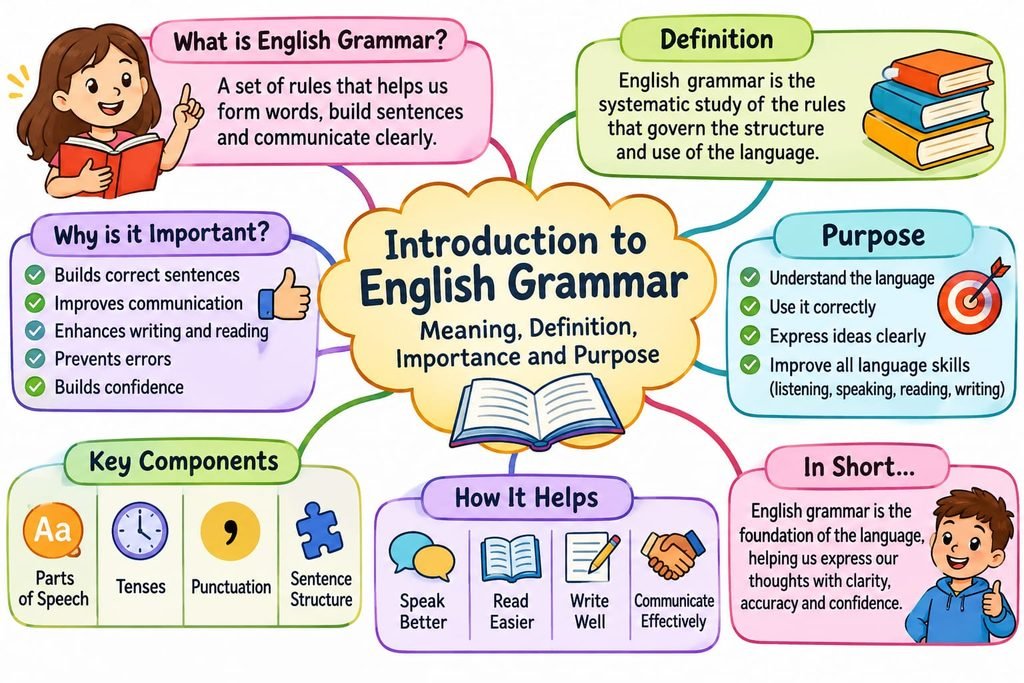
Meaning, Definition, Importance and Purpose of Grammar
1. Introduction to English Grammar
English is spoken and understood by people across many parts of the world. It serves as an important medium of communication in education, business, science, technology, literature and international relations. Millions of people use English to express their thoughts, exchange information, share knowledge and communicate with individuals from different linguistic backgrounds. However, learning a language involves much more than memorising words and understanding their meanings. It also requires an understanding of how words are arranged, how sentences are constructed and how ideas are expressed correctly. This is where English grammar becomes essential.
Grammar forms the structural foundation of the English language. It provides a systematic framework that helps speakers and writers organise words into meaningful sentences. It defines the rules and principles for forming words, structuring sentences, and understanding how different elements of language work together. Without an understanding of these principles, it may become difficult to communicate ideas clearly, accurately and effectively.
English grammar is not merely a collection of complicated rules that learners are expected to memorise. Rather, it is a practical system that enables individuals to understand how the language functions. Whether a person is speaking with someone, writing an academic essay, preparing a professional email, delivering a speech or reading a literary text, grammatical knowledge plays an important role in ensuring effective communication.
Therefore, understanding the fundamentals of English grammar is an essential step towards developing proficiency in the language.
2. Meaning of English Grammar
The word grammar refers to the system of rules and principles that governs the structure and use of a language. In English, grammar explains how words are formed, classified, modified and arranged to convey meaningful ideas.
In simple terms, English grammar teaches us how to use words correctly and how to combine them to form meaningful sentences.
For example, consider the following two sentences:
- She goes to school every day.
- She go to school every day.
Both sentences contain almost the same words, and their intended meaning is understandable. However, only the first sentence follows the standard subject-verb agreement rule. The second sentence contains a grammatical error because the verb does not agree with its singular subject.
Similarly, consider these examples:
- I am reading a book.
- Am I reading a book?
The words used in both sentences are identical, but their arrangement creates two different sentence structures. The first is a declarative sentence, whereas the second is an interrogative sentence.
These examples demonstrate that grammar influences not only the correctness of a sentence but also its structure and intended meaning.
Thus, grammar provides learners with the knowledge required to construct sentences, express questions, describe actions, communicate feelings and convey information in an organised manner.
3. Definition of English Grammar
English grammar can be defined as the systematic study of the rules and principles that govern the structure, formation and use of the English language.
It deals with the classification of words, the formation of phrases and clauses, the construction of sentences, and the relationships between different grammatical elements.
In other words, grammar explains how a language operates and provides guidelines for using it effectively in both spoken and written communication.
A simple definition:
English grammar is the study of the rules that help us form words, construct sentences and communicate ideas correctly and meaningfully in English.
4. Importance of English Grammar
Grammar plays a fundamental role in learning and mastering the English language. It helps individuals develop their speaking, writing, reading and comprehension skills. A sound understanding of grammatical principles enables learners to communicate with greater accuracy, clarity and confidence.
The following points explain why English grammar is important.
4.1. Helps in Constructing Correct Sentences
One of the primary functions of grammar is to help learners construct grammatically correct sentences. It teaches them how to arrange words in an appropriate order and how to use different grammatical elements according to established rules.
For example:
- Incorrect: He playing football.
- Correct: He is playing football.
The second sentence uses the appropriate auxiliary verb and follows the correct grammatical rules.
Understanding sentence formation enables learners to communicate their thoughts in a clear and organised manner.
4.2. Improves Communication Skills
Effective communication requires the ability to express thoughts, opinions, feelings and information accurately. Grammar helps individuals select appropriate words, arrange them logically and convey their intended meanings.
A person with a sound understanding of grammar can communicate more effectively in everyday conversations, classroom discussions, interviews, meetings and professional interactions.
Although communication does not always require perfect grammar, grammatical knowledge makes it easier to avoid misunderstandings and express ideas precisely.
4.3. Develops Writing Skills
Grammar is particularly important in written communication because readers generally depend on sentence structure, punctuation and word choice to understand the writer’s intended message.
Whether someone is writing an essay, an article, a letter, a report, a story, an application or an email, grammatical accuracy contributes to the overall quality of the writing.
A strong grammatical foundation helps writers:
- Construct meaningful sentences.
- Maintain consistency in verb tenses.
- Use appropriate vocabulary.
- Avoid unnecessary repetition.
- Apply punctuation correctly.
- Develop well-organised paragraphs.
- Express complex ideas effectively.
Consequently, grammar is an essential component of effective written expression.
4.4. Strengthens Speaking Abilities
Grammar is not limited to written English. It also plays an important role in spoken communication.
When learners understand grammatical structures, they become more capable of forming sentences spontaneously. They can describe past experiences, discuss present situations, express future intentions, ask questions and participate in conversations more effectively.
For example:
- I visited my grandparents yesterday.
- I am preparing for my examination.
- I will attend the meeting tomorrow.
An understanding of tense structures enables speakers to communicate when an action takes place.
4.5. Helps Avoid Grammatical Errors
Every language follows certain structural conventions. A lack of grammatical knowledge can result in errors involving subject-verb agreement, tense, articles, prepositions, pronouns and sentence construction.
For example:
- Incorrect: She do not like coffee.
- Correct: She does not like coffee.
- Incorrect: He is senior than me.
- Correct: He is senior to me.
- Incorrect: I have been living here since five years.
- Correct: I have been living here for five years.
Studying grammar helps learners recognise such mistakes, understand why they occur and correct them independently.
4.6. Improves Reading and Comprehension Skills
Grammar also contributes to reading comprehension. Understanding the grammatical structure of a sentence helps readers identify the relationship between different words and interpret the writer’s intended meaning.
For instance, knowledge of pronouns helps readers understand which person or object a particular pronoun refers to. Similarly, understanding conjunctions helps them recognise relationships involving contrast, reason, condition and consequence.
A good understanding of grammar therefore makes it easier to interpret complex sentences, understand paragraphs and appreciate written material.
4.7. Builds Confidence in English Communication
Many learners hesitate to speak or write in English because they are uncertain about grammatical rules. They may understand what they want to communicate but struggle to construct sentences correctly.
Learning grammar systematically can reduce this uncertainty. As learners become familiar with sentence structures, tenses, verbs, articles and other grammatical elements, they gradually develop greater confidence in expressing themselves.
Grammar should be something that builds confidence, not something that creates fear or uncertainty. Instead, it should serve as a practical tool that supports language development.
4.8. Supports Academic Development
English serves as the language of instruction in many educational institutions. Students are often required to write examinations, prepare assignments, answer comprehension questions, participate in discussions and deliver presentations in English.
A sound knowledge of grammar helps students understand academic material and express their answers appropriately.
It also supports the development of essay writing, analytical writing, creative writing and other forms of academic communication.
4.9. Enhances Professional Communication
In professional environments, English is frequently used for interviews, presentations, official correspondence, reports, meetings and discussions.
Grammatical accuracy can contribute to a professional impression by making communication clear, organised and appropriate.
For example, an individual applying for a position may need to prepare a formal application, write a professional email or introduce themselves during an interview. Knowledge of grammar helps them perform these tasks more effectively.
4.10. Develops Overall Language Proficiency
Grammar connects different aspects of language learning. It supports vocabulary development, reading comprehension, writing, speaking and listening.
When learners understand how grammatical structures function, they can use their existing vocabulary more effectively and gradually develop the ability to communicate in different situations.
Therefore, grammar is an important foundation for achieving overall proficiency in English.
5. Purpose of Learning English Grammar
The purpose of learning English grammar is not simply to memorise definitions, rules and examples. Its broader objective is to develop the ability to understand, use and communicate in English accurately and appropriately.
The major purposes of studying grammar include the following.
1. To understand the structure of the English language: Grammar introduces learners to the basic framework of English and explains how different linguistic elements work together.
2. To learn the correct use of words: It teaches learners how nouns, pronouns, verbs, adjectives, adverbs and other parts of speech function within sentences.
3. To develop sentence-building abilities: It helps learners understand how to form simple, compound and complex sentences.
4. To communicate ideas effectively: Grammar provides the structural knowledge necessary to express thoughts, opinions and information clearly.
5. To improve linguistic accuracy: It enables learners to identify and correct grammatical mistakes in both spoken and written English.
6. To understand different forms of communication: It helps learners distinguish between formal and informal expressions, statements, questions, commands and requests.
7. To develop independent language skills: It equips learners with the knowledge to evaluate their own sentences, identify errors and improve their language without depending entirely on others.
8. To appreciate the language more deeply: It helps learners understand how English has developed as a structured system and how its different elements contribute to meaning.
6. What Does English Grammar Include?
English grammar consists of several interconnected components. Each component deals with a particular aspect of language structure and usage.
The following are the major areas of English grammar:
| No. | Component | What it deals with |
| 1. | Phonetics and Phonology | The sounds and sound patterns of English. |
| 2. | Morphology | The structure and formation of words. |
| 3. | Parts of Speech | The classification and functions of words. |
| 4. | Syntax | The arrangement of words and construction of sentences. |
| 5. | Semantics | Meaning in language. |
| 6. | Tenses and Aspects | The time and progression of actions or situations. |
| 7. | Punctuation | The symbols used to organise written language. |
| 8. | Sentence Structure | The formation and classification of sentences. |
These areas are related to the broader study of language. In traditional school grammar, learners generally begin with parts of speech, nouns, pronouns, verbs, tenses and sentence formation. More advanced linguistic concepts can be introduced as their understanding develops.
7. Grammar and the Four Fundamental Language Skills
Learning a language requires developing four essential skills: listening, speaking, reading, and writing. These skills are commonly known as the four language skills, and grammar supports the development of each one.
7.1. Listening
Listening involves understanding spoken language. Knowledge of grammatical structures helps learners recognise sentence patterns, understand relationships between words and interpret spoken information.
7.2. Speaking
Speaking involves expressing thoughts and information verbally. Grammar helps learners construct meaningful sentences, use appropriate verb forms and communicate their ideas accurately.
7.3. Reading
Reading requires the ability to understand written language. Grammar enables readers to identify sentence structures, interpret clauses and understand the relationships between different parts of a passage.
7.4. Writing
Writing involves communicating ideas through written words and sentences. Grammar helps writers organise their thoughts, construct meaningful sentences and present information in a coherent manner.
All four skills contribute to language proficiency, and grammar provides important structural support for their development.
8. Is Grammar Necessary for Learning English?
Yes, grammar is an important part of learning English. However, learning grammar and learning a language should not be treated as entirely separate activities.
A learner may memorise numerous grammatical rules but still experience difficulty communicating naturally. Similarly, someone who has learned English through regular exposure and conversation may communicate effectively without knowing the technical names of grammatical structures.
For this reason, grammar should be taught alongside practical language activities.
Learners should not only study the definition of a noun or the rules of the present perfect tense but also practise using these structures in conversations, reading exercises, paragraph writing and everyday situations.
For example, after learning the simple present tense, students should practise describing their daily routines:
- I wake up early in the morning.
- My mother prepares breakfast.
- My father goes to work.
- I attend my online classes.
- We have dinner together.
Such activities allow learners to connect grammatical knowledge with practical communication.
The ultimate objective is not to produce individuals who can merely identify grammatical rules but to develop learners who can use English confidently, accurately and naturally.
9. Conclusion
English grammar is an essential foundation of effective language learning. It provides learners with an organised understanding of how words are formed, how sentences are constructed and how meaning is communicated. Its importance extends beyond academic examinations and classroom exercises because grammatical knowledge is useful in everyday conversations, professional interactions, creative writing and formal communication.
A systematic understanding of grammar enables learners to improve their vocabulary usage, develop sentence construction skills, strengthen their reading comprehension and express their thoughts more precisely. It also helps them recognise grammatical errors and become more independent users of the language.
However, grammar should not be approached merely as a subject involving the memorisation of rules and definitions. It should be studied as a practical system that supports the development of all four language skills: listening, speaking, reading and writing.
Whether a person is a young learner taking the first steps towards understanding English or an advanced student seeking greater linguistic proficiency, grammar remains an important part of the learning process.
Ultimately, the purpose of learning English grammar is to understand the language, use it correctly and communicate ideas with clarity, confidence and precision.
END OF CHAPTER 1
Suggested exercises for this chapter
- What is English grammar?
- Define English grammar in your own words.
- Why is grammar considered the foundation of a language?
- Explain any five reasons why learning English grammar is important.
- How does grammar contribute to effective communication?
- What are the four fundamental language skills?
- Explain the relationship between grammar and writing.
- Is memorising grammatical rules sufficient to become proficient in English? Explain your answer.
- What are the major components of English grammar?
- Write a short paragraph explaining the importance of learning English grammar.